Bridge to Infinity
The 20th century tried to reach space with fire. The 21st century builds a bridge.
Imagine the journey.
Three g, sustained: a firm, even weight pressing you into the reclined seat. The cabin is small. Twelve people. Everyone breathing steadily against the load.
You are inside a mountain, accelerating through an evacuated shaft bored through bedrock. The coils fire in sequence. No roar. No vibration. Just the low hum of grid electricity becoming speed. Thirty seconds. Eight hundred and fifty metres per second.
The tunnel curves toward vertical. The push shifts sideways, centripetal, building. Three g becoming five, briefly touching seven at the tightest bend. Twenty seconds of roller-coaster geometry through the mountain’s shoulder. Then it eases.
And silence.
The vehicle coasts up the pylon in vacuum. Sixteen seconds of weightlessness. Through the window, the sky is black. Stars steady against deep indigo. The curve of the Earth runs pale along the southeast horizon. Twenty kilometres up, the air outside is less than a tenth of what it was on the ground.
The exit is gentle. At seven hundred metres per second, the thin air presses softly, less dynamic pressure than a rocket ever faces at Max Q. The lifting body banks: one smooth roll, about one g. Then the engine lights: a nudge, under one g, building over seven minutes to five g in the final seconds as propellant burns off. Most of the burn is below three g. Quieter than turbulence.
Finally. Cutoff.
Orbit.
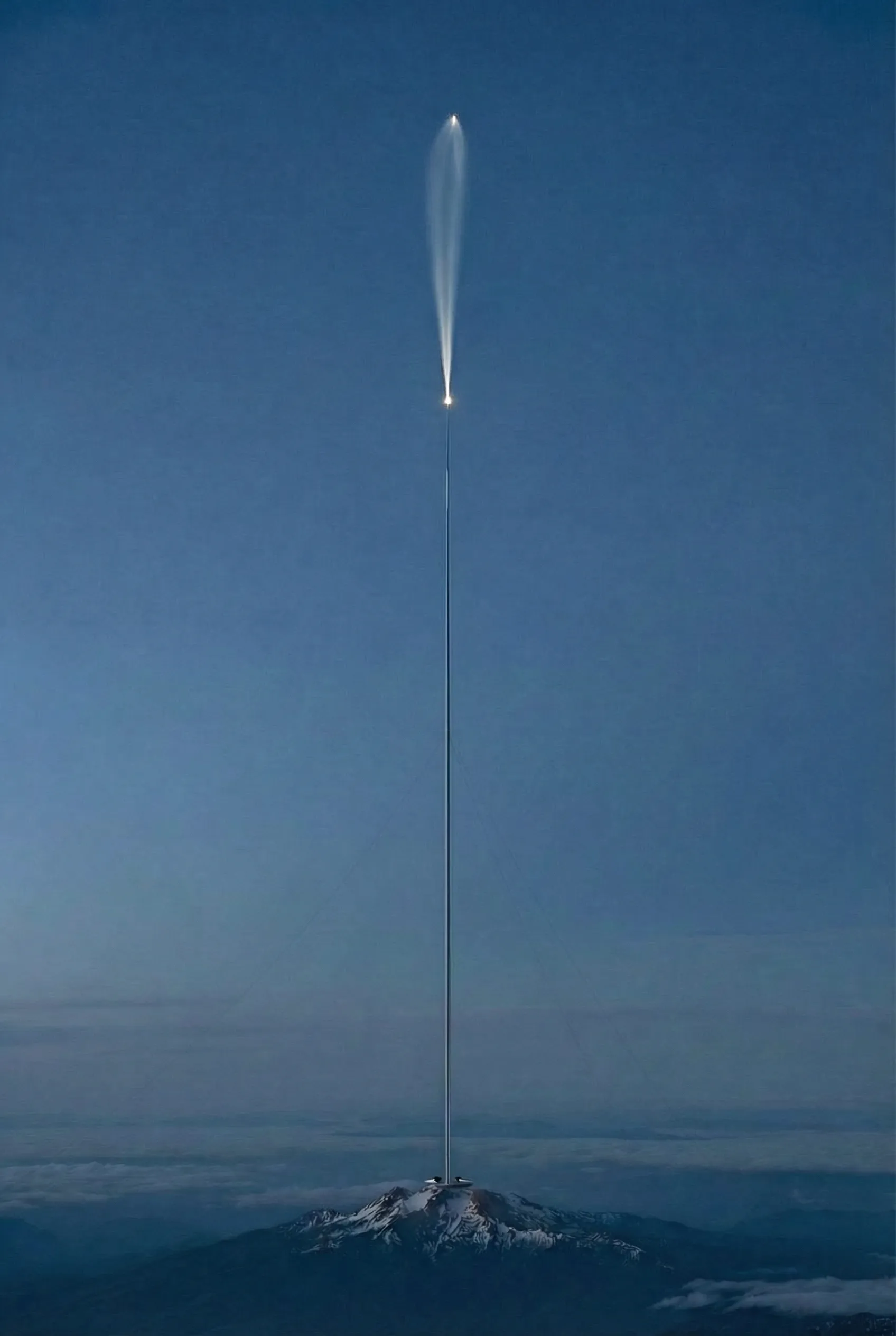
I. The Sky We Leave Behind
To reach orbit, a spacecraft must gain speed while climbing through air.
A spacecraft in low Earth orbit moves at roughly 7.8 km/s. Fast enough to circle the planet in ninety minutes. But reaching orbit from the ground costs closer to 9.2 km/s.[1] That extra 1.4 km/s is almost entirely wasted fighting gravity and air. These losses compound exponentially through the rocket equation.[2]
Max Q—the moment of greatest aerodynamic pressure—shapes the vehicle’s shell, structure, and engine schedule. Rockets are built around ninety seconds of dense air.
Reusable rockets will bootstrap the space economy, pushing costs toward $50–200/kg and seeding the first lunar industry. But chemical rocketry through dense atmosphere faces a throughput ceiling that has nothing to do with cost. Every launch deposits combustion products, soot, aluminium oxide, water vapour, directly into the stratosphere, where they accumulate.
NOAA-affiliated research shows non-linear stratospheric ozone and climate damage at roughly 10× current launch rates.[3] Measurements already detect spacecraft re-entry metals in stratospheric aerosol at today’s cadence.[4] Moving civilisation off-Earth requires not 10× but 400–1,000× current orbital throughput, megatonnes per year, sustained for decades.
Rockets are the horse. The Bridge is the railroad.
II. A Needle Through the Atmosphere
The proposal is infrastructure: a vertical electromagnetic launcher, embedded in a mountain, reaching through the stratosphere.
Meridian.
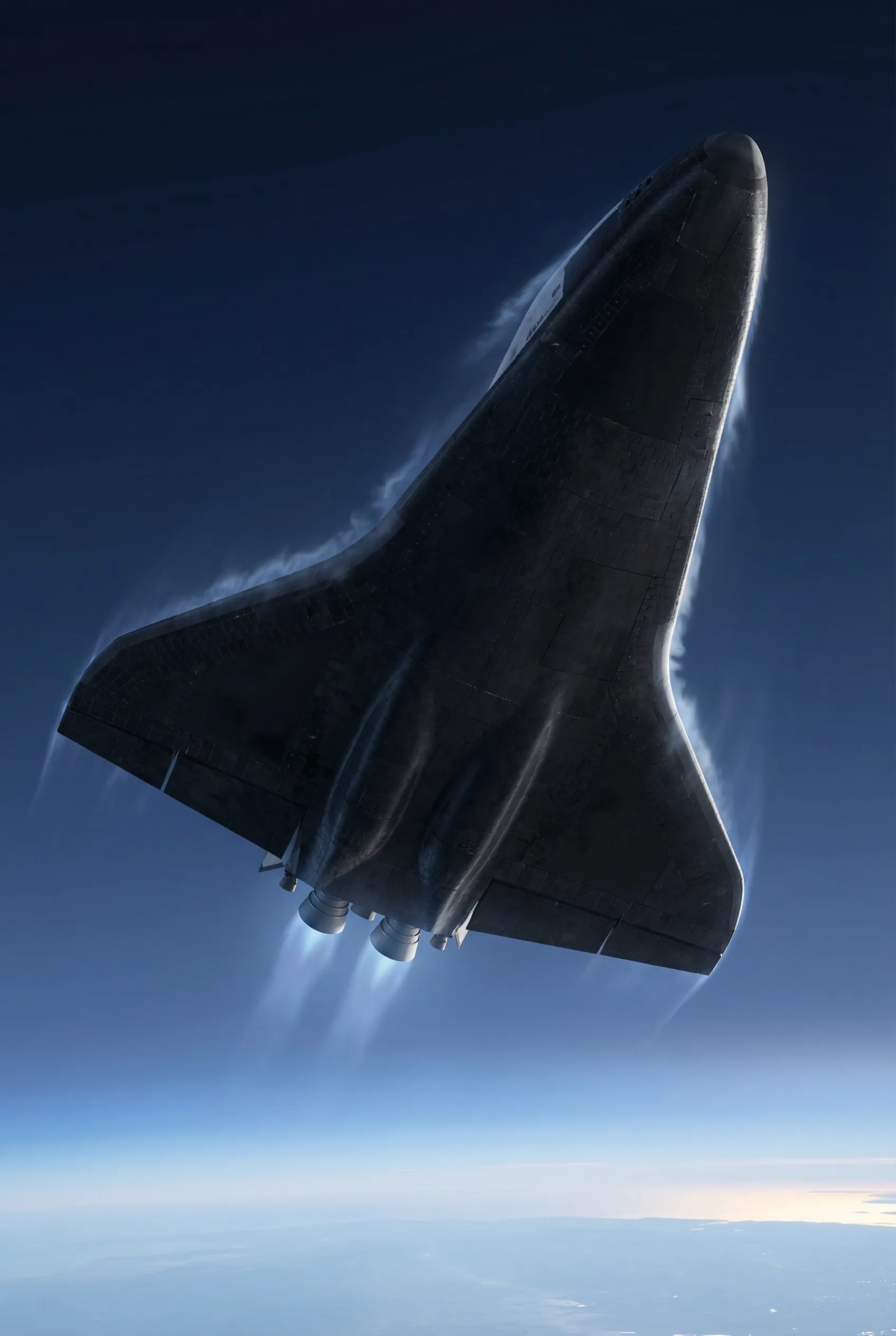
A tunnel accelerates the vehicle through bedrock. A pylon carries it from the summit into the stratosphere. At altitude, the lifting body banks, turning towards the horizon before the engine has burned a gram of propellant (Appendix C2, E).
Twenty kilometres is where three conditions coincide. Thick enough for a lifting body to bank: 7% of sea-level density gives real aerodynamic authority at even modest speeds. Sparse enough that the exit pulse is brief and structurally manageable, gentler than re-entry, which is already solved. And high enough that the aerodynamic bank carries the vehicle to ~28–29 km before the engine lights.
At that altitude, atmospheric pressure is under 2% of sea level. The engine fires in effectively true vacuum from ignition, at 99%+ of its theoretical efficiency. No other exit altitude satisfies all three as cleanly.
The bank turns vertical speed towards the horizon. In the idealised geometry, gaining a hundred metres per second sideways costs about seven metres per second of climb speed. Call it the Pythagorean Dividend (Appendix C2). Drag still takes its share. The stratosphere becomes a gearbox, turning part of the launcher’s vertical throw into speed the orbital stage can use.
Electricity provides the throw. Thin air provides the turn. Vacuum provides the burn. Each layer does less work because the one before it did more. The rocket equation amplifies every saving exponentially.
III. The Mountain is a Stage
Once the atmosphere is someone else’s problem, the orbital stage transforms.
Call it Halcyon. It ignites in near-vacuum, already banked toward the horizon. Its nozzle can expand fully for space. The same lifting body that turns through the thin air comes home to a runway, using the re-entry techniques that reusable spacecraft have developed (Appendix C3).[5]
And it can use hydrogen.
Ground vehicles default to dense propellants that survive Max Q. Hydrogen offers far higher exhaust velocity, but its bulk punishes sea-level flight. Meridian removes that constraint. The engine fires a pure vacuum nozzle at full expansion ratio. It is like the second stage of a two-stage rocket.[6]
In the cargo model, hydrogen and oxygen cut propellant by 64% against the all-rocket kerosene baseline; the gentler crewed flight saves 58% (Appendix D). Halcyon’s broad body gives the bulky hydrogen somewhere to go. Nuclear thermal propulsion offers a later upgrade (Appendix M).[7]
Engineers have chased the spaceplane since the 1960s. A reusable single-stage-to-orbit vehicle must fit structure, propellant, and payload inside an unforgiving mass budget. The X-33 and VentureStar ran into that constraint (Appendix Q). Meridian moves the starting line to 20 km. In the model, that leaves room for a reusable vehicle and useful cargo.
The mountain carries what the vehicle never could.
IV. A Timetable to Orbit
The difference between a space programme and a space economy is cadence. A mature orbital economy needs the regularity of ports, rail, and container shipping.
The port. Meridian is fixed infrastructure, used constantly, maintained on schedules, amortised over decades. It never moves. Electricity is Meridian’s main variable input. Vehicle propellant, maintenance, and amortisation set the delivered price.
The locomotive. Halcyon: a reusable lifting body, optionally crewed, that mates with Meridian, completes orbital insertion in near-vacuum, glides back to a runway, and turns around for the next flight.
The container. Standardised cargo pods, sized to the launcher bore and the shuttle bay. The container is cheap. The locomotive is expensive. You replace containers. You maintain locomotives.
The throughput changes the conversation. In 2024, all of humanity put roughly 2,171 tonnes into orbit.[8] One launcher at daily cadence delivers more than ten times that. Faster cadences scale toward 400× the world’s annual upmass at a shot an hour.
V. The Moon Supplies the Bricks
The Moon is the natural source of bulk mass for space.
The Moon’s gravity well is 22 times shallower than Earth’s.[9] The energy to lift a kilogram of structural aluminium from the Moon to cis-lunar orbit is less than one-twentieth the energy to lift the same kilogram from Earth.[10] And the Moon has no atmosphere, no vacuum tube, no aerodynamic heating, no Max Q. A lunar mass driver is roughly 14 km of track at 20g under open sky, powered from crater rims where the Sun almost never sets.
Launching processed material from the Moon into cis-lunar orbit costs roughly $0.04/kg in electricity. Processing the regolith costs far more. The gravity well is the part that disappears.[11]
The Moon’s crust is exactly the inventory a space civilisation needs for bulk construction: oxygen, silicon, aluminium, iron, magnesium, calcium, titanium.[12] Structural metals, glass, ceramics, radiation shielding, the heavy, voluminous things that dominate construction mass and are expensive to launch from Earth because there is so much of them.
The round-trip light time to the Moon is about 2.6 seconds: too slow for direct reflexes, fast enough for supervised teleoperation of industrial robots, excavators, and fabrication systems.[13] The first lunar industrial base runs on machines and a data link.
The Moon supplies the bricks. Electricity lifts them.
An O’Neill-scale rotating habitat for 10,000 people might mass 150,000 tonnes. If the Moon supplies 90% of that as structural bulk, Earth only needs to export roughly 15,000 tonnes per habitat, about 1.5 tonnes per person. As orbital fabs mature, the per-capita burden decays toward an irreducible floor of genuinely Earth-origin things: semiconductors, biological diversity, precision instruments, cultural capital. The full decay model is in Appendix L.
Housing is one task; carrying people there is another. A passenger needs a vehicle, propellant, life support, and reserves. Reuse makes the journey cheaper over time. Cargo goes first, until the fare falls far enough that millions can choose to follow.
Earth exports the blueprint. The Moon exports the bricks. Cis-lunar space builds the city.
VI. For a City Between Two Worlds
An economy needs supply chains that close, transactions that settle, and machines that take instructions. Across the Earth–Moon system, a signal returns in under three seconds: slow enough to notice, fast enough to coordinate. Beyond the Moon, the delay grows quickly. Cis-lunar space can still function as one economy because its machines, markets, and people can answer one another.[14]
Meridian makes orbit cheap. Latency defines how far the economy stretches.
Inside that neighbourhood, industry migrates in a specific order.
Heavy industry goes first. Smelting, refining, and chemical processing generate heat and waste Earth’s biosphere must absorb. In space, radiators discharge heat into the dark. Feedstock arrives from the Moon. Power follows industry. At the right high orbit, sunlight is nearly continuous. Computation follows power. Then workers. Then families. Then cities.
Each arrival depends on the one before it. Population follows closed logistics, the same way every city in history was a port or a crossroads before it was a home.
VII. The Earth Breathes
For three centuries, industrial civilisation has used Earth’s atmosphere as a chimney, its rivers as coolant, its crust as a mine, and its ecosystems as a buffer against the side effects of production.
Meridian changes that.
Once heavy industry can operate in space, powered by continuous solar energy, fed by lunar material, cooled by radiators facing the void, the pressure on Earth’s biosphere begins to reverse.
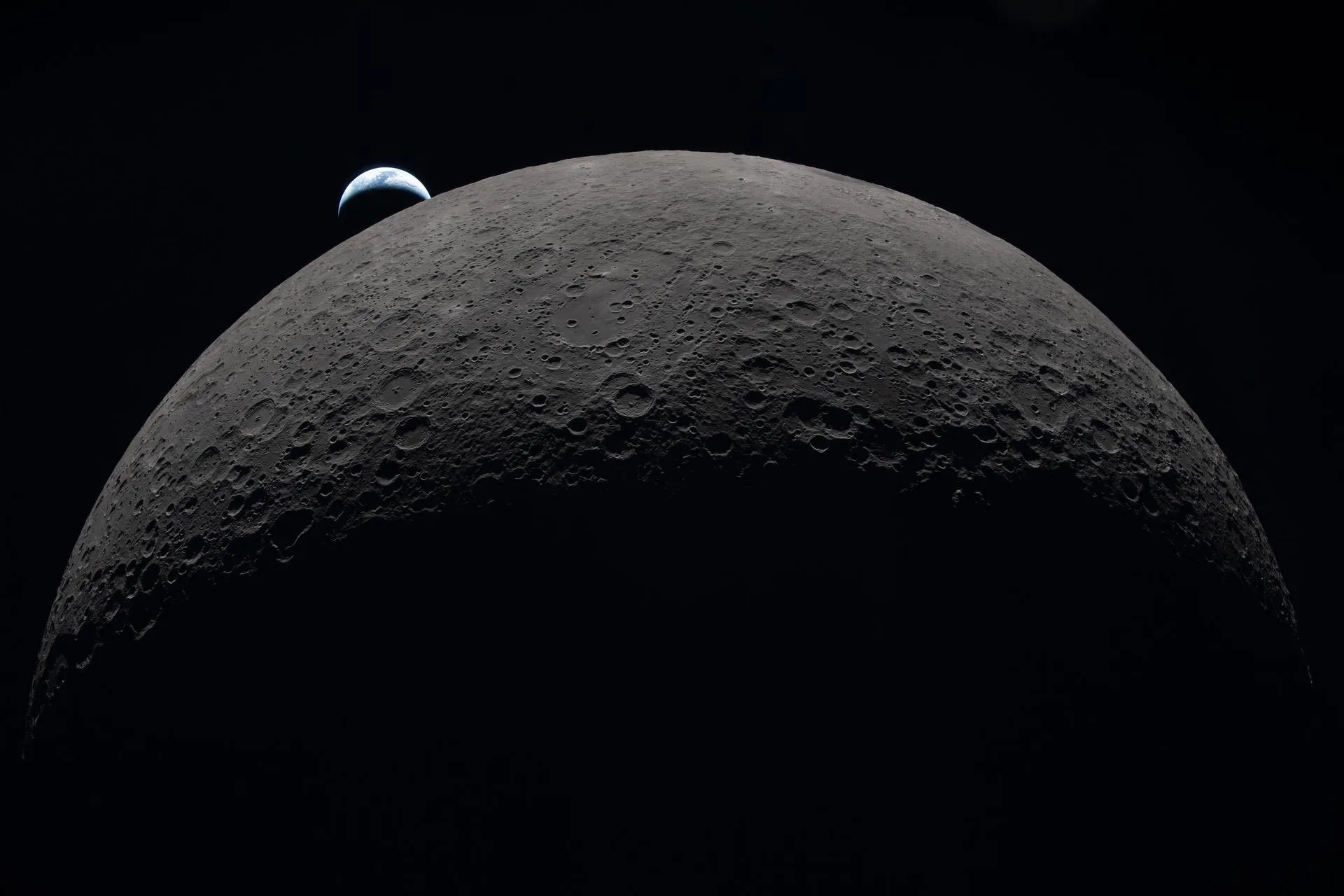
The atmosphere stops absorbing industrial waste heat. The oceans stop receiving runoff from extraction. Mines close because their products are better sourced from the Moon. Smelters, refineries, and chemical plants migrate to orbital platforms where their emissions no longer enter a living biosphere.
Space industry manufactures infrastructure for space residents: habitat shells, solar arrays, structural trusses, propellant tankage, radiator panels. The output stays in space because the customers are in space. At scale, the orbital economy consumes its own output to grow.
Earth becomes selective about what it hosts. Biology. Culture. Agriculture on land that was never strip-mined. Forests that were never cleared for industry. Rivers that run clean because no one is using them as coolant.
Earth needs civilisation to grow large enough to move its heaviest footprint somewhere else. Give it a larger canvas. The footprint shrinks.
Meridian has its own costs: solar land use, electrolysis water demand, re-entry aerosols, orbital debris governance. Each demands serious engineering (Appendix N).[15][4][16][17] But the sum of managed externalities at scale is categorically smaller than continuing to use Earth’s biosphere as a process buffer.
VIII. Building Our Cathedral
This will be a programme of infrastructure built across generations, the way cathedrals were built, by people who knew they would never see the finished work, for communities that did not yet exist.
Each phase depends on the one before it. Rockets bootstrap the lunar economy. The lunar economy justifies Meridian. Meridian feeds the orbital build-out. The build-out creates the demand that pulls industry, then populations, off-world. The chain ends with the free starships: vessels that can leave the supply line behind.
Once Meridian is built, the cost of orbit drops to electricity and process engineering. The Moon supplies the mass. Earth supplies only the complexity. Cis-lunar industry builds what cis-lunar residents need.
And Earth becomes what it always could have been.
Our Pale Blue Dot.
Technical Appendix
The appendices follow the design from ascent to settlement. Their reference cases use different mass and energy boundaries:
| Question | Read | Comparison boundary |
|---|---|---|
| What reaches the orbital stage? | A–C3 | Atmosphere, trajectory, bank, and exit loads; crew and cargo remain separate. |
| How much propellant is saved? | D–D2 | 100 t post-burn mass; reference cargo engine duty 7.2 km/s. |
| What must be built? | E–F2 | Shared bore, terminal structure, and the pylon-free alternative. |
| What does transport cost? | G–K | Launcher energy, lunar export, and delivered payload; K uses 7.7 km/s. |
| What happens at scale? | L–P | Settlement scenarios and industrial burdens; M uses 7.3 km/s, while O retains its stated 116 kWh/kg case. |
| What can break the proposal? | Q–R | Payload margin and dated or engineering-dependent falsifiers. |
Keep post-burn mass distinct from payload, kinetic energy from wall-plug energy, and energy cost from the full delivered price. Each calculation states its own assumptions.
A. Atmospheric Density and the 95% Line
The launcher exit dynamic pressure is high and useful.
Using the U.S. Standard Atmosphere (1976),[18] air density falls approximately exponentially with altitude:
| Altitude (km) | (kg/m³) | % of sea-level density | Cumulative mass above (%) |
|---|---|---|---|
| 0 (sea level) | 1.225 | 100% | 100% |
| 10 | 0.414 | 33.8% | ~26% |
| 20 | 0.089 | 7.3% | ~5.5% |
| 25 | 0.039 | 3.2% | ~2.5% |
| 30 | 0.018 | 1.5% | ~1.2% |
Atmospheric pressure at altitude approximates the weight of the overlying air column: , where km is the scale height. Since pressure is proportional to the mass of air above, ~94% of atmospheric mass lies below 20 km, ~97% below 25 km, and ~99% below 30 km (the body’s “95% below 25 km” is the conservative round).
Dynamic pressure at launcher exit:
| Exit altitude | (kg/m³) | = 2.5 km/s | = 3.0 km/s |
|---|---|---|---|
| 20 km | 0.089 | 278 kPa | 401 kPa |
| 25 km | 0.039 | 122 kPa | 176 kPa |
| 30 km | 0.018 | 56 kPa | 81 kPa |
For comparison, a typical rocket experiences Max Q of 30–40 kPa at ~12 km altitude and ~500 m/s. A lower exit (20–25 km) exposes the vehicle to more air. More air means higher aerodynamic authority for the bank manoeuvre that converts surplus vertical velocity into horizontal momentum (Appendix C2).
A lower exit shortens the pylon and increases aerodynamic authority. At 20 km, the purpose-built cargo model gains about 500 m/s horizontally. Its 3 km/s climb carries it rapidly through the highest-pressure layer.
B. Launch Budget Decomposition
The benefit of altitude is atmospheric bypass, not orbital mechanics.
A representative NASA launch budget for a 200 km circular orbit:[1]
| Component | (km/s) | Notes |
|---|---|---|
| Ideal surface-to-orbit | 7.97 | Vis-viva from surface to 200 km circular |
| Earth rotation credit | −0.41 | At 28.5° latitude (Cape Canaveral class) |
| Gravity loss | +1.10 | Propellant spent fighting gravity during ascent |
| Drag loss | +0.50 | Propellant spent overcoming aerodynamic drag |
| Steering loss | +0.10 | Trajectory shaping and guidance corrections |
| Total rocket | 9.26 |
Circular orbital speed at 200 km: km/s.
What the launcher removes. A near-vertical electromagnetic assist to ~20 km altitude and ~3 km/s upward velocity eliminates or sharply reduces:
- Drag loss (~0.5 km/s): payload exits above 93%+ of the atmosphere
- Gravity loss (~0.9–1.1 km/s): all but eliminated. The launcher does the vertical climb electromagnetically (no engine burn, no gravity loss during ascent). The lifting body banks immediately after exit, converting vertical momentum into horizontal momentum aerodynamically before engine ignition, so the powered burn begins near-horizontal and nearly perpendicular to the gravity vector
- Steering loss (~0.1 km/s): the vacuum stage can pitch directly to optimal burn attitude
- Additional: the aerodynamic bank converts ~100–500 m/s of surplus vertical velocity into horizontal momentum at zero propellant cost, depending on vehicle class (~500 m/s for purpose-built cargo at 3 km/s, ~100 m/s for human-rated at 700 m/s with full bank. See Appendix C2)
The cargo budget removes roughly 1.5 km/s of launch losses and credits another 500 m/s to the bank, leaving about 7.2 km/s for the engine. The human case exits at 700 m/s, gains about 100 m/s aerodynamically, and assigns about 7.8 km/s to the engine. See Appendix C2.
Altitude vs velocity contribution. The change in required circular orbital speed due to the slightly larger orbital radius at 30 km is:
The 19 m/s change is negligible beside the atmospheric and gravity-loss savings.
C. Ballistic Arc and Burn Window
These unpowered arcs define the coasting envelope. The intended stage banks and ignites seconds after exit, so its powered trajectory departs from the table almost immediately.
From an exit altitude with vertical velocity , the additional height gained on an unburned arc:
where m/s² at 20 km (negligibly less than surface ).
| Exit altitude | (km/s) | Additional height | Apogee altitude | Time to apogee | Total time above exit |
|---|---|---|---|---|---|
| 20 km | 0.7 (human) | 25 km | 45 km | 71 s (1.2 min) | ~2.4 min |
| 20 km | 2.5 | 319 km | 339 km | 255 s (4.3 min) | ~9 min |
| 20 km | 3.0 (cargo) | 459 km | 479 km | 306 s (5.1 min) | ~10 min |
| 25 km | 3.0 | 459 km | 484 km | 306 s (5.1 min) | ~10 min |
| 30 km | 3.0 | 459 km | 489 km | 306 s (5.1 min) | ~10 min |
The 3 km/s cargo case has roughly ten minutes above its 20 km exit altitude without a burn. The intended bank gains about 500 m/s before ignition; the powered ascent uses that speed rather than following the full ballistic arc. See Appendix C2.
For a cargo hydrolox stage with km/s (after ~500 m/s aero credit at 20 km), a 5-minute burn (300 s) gives average acceleration m/s², or about 2.4 g—a reasonable upper-stage acceleration for cargo. The crewed vehicle burns for ~7 minutes from 0.9 g to 5 g (85% below 3 g); its 2.4-minute ballistic window is extended by wing lift and centrifugal effects, so the burn fits comfortably. See Appendix E.
C2. Aerodynamic Turn Optimisation
The cargo model supplies about 3 km/s vertically while reserving roughly 500–700 m/s to remain above the atmosphere during the burn. The bank converts part of the surplus to horizontal velocity. The following approximation estimates that conversion.
Closed-form solution. Air density falls exponentially with altitude: where km is the scale height. For a vehicle climbing at velocity , altitude increases as , so .
The lateral acceleration from aerodynamic lift is:
Integrating over the entire climb (the exponential decay makes the integral converge):
This is exact in the limit of constant climb speed (a good approximation: the vehicle loses only ~2–3% of its 3 km/s to gravity during the ~3 s of significant aero authority). Aero delta-v scales linearly with exit density , exit speed , scale height , and the vehicle’s lift parameter .
Since , every km lower in exit altitude doubles the free delta-v (each 7.5 km multiplies it by ). This is why exit altitude matters so much.
Wing loading. The formula uses full exit mass, including propellant. A 50 t payload with hydrolox for a 7.2 km/s burn gives roughly 484 t at exit.
Runway landing sets planform area through . With , substitution gives:
Absolute mass cancels. Landing wing loading, lift coefficient, exit density, and mass ratio determine the result. A heavier vehicle requires proportionally more planform.
For a purpose-built cargo drone landing at N/m² (approach speed ~130 knots, comparable to a regional airliner) with at ~30° hypersonic AoA, carrying 50 t of payload and ~390 t of hydrolox at exit (): planform area ~490 m² (~31 m × 16 m), total exit mass ~484 t. At 20 km exit this gives ~500 m/s—half a kilometre per second of free horizontal velocity, earned from the air itself.
Design envelope. For a 50 t payload at km/s, hydrolox, , solved self-consistently ( and co-determined):
| Exit altitude | (kg/m³) | (kPa) | Aero (conservative) | Aero (purpose-built) | Peak lateral (conservative) | Peak lateral (purpose-built) |
|---|---|---|---|---|---|---|
| 15 km | 0.195 | 878 | 527 m/s | 1,097 m/s | 21 g | 44 g |
| 18 km | 0.122 | 549 | 329 m/s | 686 m/s | 13 g | 28 g |
| 20 km | 0.089 | 401 | 240 m/s | 501 m/s | 10 g | 20 g |
| 22 km | 0.065 | 293 | 175 m/s | 366 m/s | 7 g | 15 g |
| 25 km | 0.039 | 176 | 105 m/s | 219 m/s | 4.3 g | 9 g |
| 28 km | 0.024 | 108 | 65 m/s | 135 m/s | 2.6 g | 5.5 g |
| 30 km | 0.018 | 81 | 49 m/s | 101 m/s | 2.0 g | 4.1 g |
Conservative: N/m², , (smaller planform, moderate bank). Purpose-built: N/m², , (large planform, aggressive bank). Both columns are self-consistent: is computed from the remaining stage duty after aero credit.
Peak lateral is the instantaneous load at exit, decaying to 37% within 2.5 seconds () as the vehicle climbs into thinner air. These are brief pulses, not sustained loads.
G-load constraints and optimal exit altitude. The peak lateral acceleration at exit is:
Setting this equal to a g-limit and solving for the maximum density (minimum altitude):
| Payload class | -limit | Min exit altitude (conservative) | Min exit altitude (purpose-built) |
|---|---|---|---|
| Bulk cargo | 30 g | ~14 km | ~17 km |
| Rugged cargo | 20 g | ~16 km | ~19 km |
| Sensitive cargo | 10 g | ~21 km | ~24 km |
| Human-rated at 3 km/s (brief 5g peak) | 5–7 g | ~24–26 km | ~27–29 km |
The table applies at 3 km/s, where exit pressure at 20 km is about 401 kPa. The human vehicle uses a lower speed.
The human vehicle exits at ~700 m/s. At that speed, exit dynamic pressure is only ~22 kPa, gentler than a rocket’s Max Q. The peak lateral g at full bank () is:
The vehicle banks at full authority with g-loads at level flight. The aero delta-v at full :
Aero credit scales with speed; peak load scales with its square. At 700 m/s, full bank gives about 100 m/s credit at 1 g, versus about 500 m/s for cargo at 3 km/s. Most human-case savings come from the electromagnetic climb and reduced ascent losses.
Exit altitude and pylon height. Lower exits increase lift authority, subject to payload loads and heating. The reference design also needs a terminal structure that can be built from its summit.
| Summit altitude | Pylon height | Exit altitude | Aero (cargo 3 km/s, purpose-built) | Aero (human 700 m/s, full bank) | Human peak g |
|---|---|---|---|---|---|
| 5 km | 10 km | 15 km | 1,097 m/s | ~230 m/s | ~2.2 g |
| 5 km | 15 km | 20 km | 501 m/s | ~105 m/s | ~1.0 g |
| 8 km | 12 km | 20 km | ~500 m/s | ~105 m/s | ~1.0 g |
| 8 km | 10 km | 18 km | 686 m/s | ~143 m/s | ~1.4 g |
| 8 km | 15 km | 23 km | 310 m/s | ~65 m/s | ~0.7 g |
At 700 m/s, the tabulated human loads remain below 3 g, allowing full bank. Lowering the exit from 20 to 15 km raises its credit from about 105 to 230 m/s. Cargo at 3 km/s gains about 1,100 m/s at 15 km but faces a 44 g peak.
Propellant savings across the design envelope. For hydrolox ( = 465 s, 100 t post-burn mass):
| Exit altitude | Aero (cargo) | Engine duty | Mass ratio | Propellant (t) | Savings vs 9.2 km/s kerolox |
|---|---|---|---|---|---|
| 30 km (launcher only) | ~0 | 7.7 km/s | 5.41 | 441 | 59% |
| 25 km | ~220 m/s | 7.5 km/s | 5.18 | 418 | 61% |
| 20 km | ~500 m/s | 7.2 km/s | 4.84 | 385 | 64% |
| 18 km | ~690 m/s | 7.0 km/s | 4.64 | 364 | 66% |
| 15 km | ~1,100 m/s | 6.6 km/s | 4.27 | 327 | 70% |
For NTP ( = 900 s):
| Exit altitude | Aero (cargo) | Engine duty | Mass ratio | Propellant (t) | Savings vs 9.2 km/s kerolox |
|---|---|---|---|---|---|
| 30 km (launcher only) | ~0 | 7.7 km/s | 2.40 | 140 | 87% |
| 20 km | ~500 m/s | 7.2 km/s | 2.26 | 126 | 88% |
| 15 km | ~1,100 m/s | 6.6 km/s | 2.12 | 112 | 90% |
Drag penalty. At , drag costs about half the lift impulse from the vertical velocity budget. But the vehicle has ~3 km/s vertical and needs only ~500–700 m/s residual. Even at 1,100 m/s of aero delta-v with drag loss of ~550 m/s, the vehicle retains ~2,375 m/s vertical after drag and gravity losses.
In the stated envelope, climb speed remains after the bank and drag losses. The landing-sized planform supplies lift authority while the vehicle crosses thinning air; drag still consumes energy.
Reference design summary. For an 8 km summit with a 12 km tension-stabilised pylon (20 km exit), 50 t payload:
| Vehicle class | Peak g in curve | Exit velocity | Aero Δv | Engine duty (hydrolox) | Propellant per 100 t | Savings |
|---|---|---|---|---|---|---|
| Human-rated | 7 g | 700 m/s | ~105 m/s | 7.8 km/s | 453 t | 58% |
| Sensitive cargo (electronics, optics) | 15 g | ~1.1 km/s | ~165 m/s | 7.6 km/s | 430 t | 60% |
| Standard cargo (machinery, tanks) | 30 g | ~1.6 km/s | ~240 m/s | 7.5 km/s | 418 t | 61% |
| Ruggedised cargo (bulk metal, water) | 50 g | ~2.1 km/s | ~315 m/s | 7.4 km/s | 407 t | 62% |
| Hardened cargo (aggregate, probes) | 100 g | ~3.0 km/s | ~500 m/s | 7.2 km/s | 385 t | 64% |
All five classes share a roughly 30 km bore—12 km linear and 18 km curvilinear—and the same pylon. The coils change their acceleration programme with the manifest. Curve loads range from 7 g for people to 100 g for hardened freight.
The Pythagorean Dividend. In an ideal constant-speed bank, . A modest horizontal gain consumes a small part of the larger vertical component:
| Case | Initial vertical | Aero Δv gained | Vertical after bank | Apogee tax | Tax (%) |
|---|---|---|---|---|---|
| Cargo (3 km/s exit) | 3,000 m/s | 500 m/s | m/s | 42 m/s | 1.4% |
| Human (700 m/s exit) | 700 m/s | 100 m/s | m/s | 7 m/s | 1.0% |
The cargo example trades 42 m/s of vertical velocity for 500 m/s horizontally before drag and gravity losses.
Why 700 m/s for humans. Turn radius scales as . At 852 m/s near the summit and 5 g, it is about 15 km. The same curve gives cargo at 3 km/s roughly 60–90 g. Lowering exit speed reduces dynamic pressure from 401 to 22 kPa but raises propellant from 385 to 453 t per 100 t post-burn mass. Savings fall from 64% to 58%; atmospheric bypass still supplies most of the benefit.
The design uses electricity for climb, residual air for the turn, and near-vacuum for the burn. Lower exit altitude trades greater aerodynamic authority against higher loads; the vehicle and pylon must close together.
C3. Cargo Structural and Thermal Survivability at Exit
The cargo reference design exits at 3 km/s, 20 km altitude, Mach ~10. Dynamic pressure is 401 kPa—roughly 10× a rocket’s Max Q. The calculations below estimate the brief thermal and structural loads that follow.
Reference vehicle. 50 t payload, 10% dry fraction, hydrolox propellant for 7.2 km/s engine duty. Total mass at exit t. Planform m² (~31 m × 16 m) set by runway landing wing loading.
1. Aerodynamic Loads
Speed of sound at 20 km: m/s. Mach number at exit: .
Dynamic pressure: kPa.
Stagnation (total) pressure at the nose: Using the normal-shock Rayleigh Pitot formula at :
For scale, 7.1 bar is below a fire extinguisher’s 12–15 bar and a scuba cylinder’s 200–300 bar. Those pressure ratings do not establish the strength of this heated lifting body; the following estimates address its loads.
Force decomposition during the aero bank (, ):
- Lift (centripetal): MN →
- Drag (axial deceleration): MN →
- Combined load vector: peak
Duration. The aerodynamic forces decay exponentially as the vehicle climbs into thinning air. The e-folding time is s.
| Time after exit | Force as % of peak | Cumulative impulse |
|---|---|---|
| 0 s | 100% | 0% |
| 1.7 s | 50% | 50% |
| 2.5 s | 37% | 63% |
| 5.0 s | 14% | 86% |
| 7.5 s | 5% | 95% |
The model stays above half peak force for 1.7 seconds and delivers 95% of its impulse within 7.5 seconds.
2. Thermal Loading
Using the Sutton-Graves stagnation-point heat-flux approximation with nose radius m:
Since density decays as , heating rate decays as . Integrating:
Comparison to known re-entry systems:
| Event | Peak heat flux | Duration | Total heat load |
|---|---|---|---|
| Cargo exit (3 km/s, 20 km) | 1.47 MW/m² | ~5 s effective | 7.4 MJ/m² |
| Shuttle re-entry (orbital) | ~500 kW/m² | ~1,200 s | ~600 MJ/m² |
| Dragon re-entry (orbital, PICA-X) | ~3–5 MW/m² | ~300–500 s | ~1,500 MJ/m² |
| Apollo lunar re-entry | ~50 MW/m² | ~200 s | ~10,000 MJ/m² |
The cargo exit total heat load is ~200× less than Dragon’s re-entry. Dragon’s PICA-X heat shield absorbs ~1,500 MJ/m². The cargo vehicle nose needs a few millimetres of ablator (graphite or PICA) to absorb 7.4 MJ/m². The rest of the vehicle surface sees roughly 10–30% of stagnation heating, reducing the average body heat load to ~0.7–2.2 MJ/m²—manageable with standard aerothermal coatings.
3. Structural Analysis
Wing root bending (dominant structural load). Lift of 98.2 MN acts across half the span (~8 m average moment arm). Bending moment at wing root:
For a realistic CFRP wing-root box beam (root chord 16 m, thickness ratio 7%, structural material 25% of cross-section, m to neutral axis):
CFRP allowable in bending: 800–1,500 MPa. Margin: 10–19×. Even at 100 g for hardened cargo, bending stress remains below 380 MPa—still within standard CFRP allowable with margin.
Acoustic environment. An attached turbulent boundary layer at Mach 10 generates surface pressure fluctuations of ~0.5–1% of dynamic pressure (RMS). At kPa, RMS fluctuation ~2–4 kPa → ~160–166 dB OASPL for ~3 seconds. This matches the acoustic environment at rocket Max Q (Falcon 9: ~160 dB; Shuttle: ~162 dB) and is within the qualification envelope of military-rated avionics. Duration is 3 seconds vs a rocket’s sustained Max Q. Fatigue cycles are negligible.
4. Integrated Stress Comparison: Exit vs Re-entry
Compare peak loads separately from duration and integrated exposure:
| Load | Cargo exit (3 km/s, 20 km) | Dragon orbital re-entry | Ratio |
|---|---|---|---|
| Peak g | ~23 g | ~4–6 g sustained (longer) | — |
| Total aero impulse | ~570 m/s equivalent | ~7,800 m/s equivalent | ~14× less |
| Peak heat flux | 1.47 MW/m² | 3–5 MW/m² | 2–3× less |
| Total heat load (stag) | 7.4 MJ/m² | ~1,500 MJ/m² | 200× less |
| Acoustic duration at ~160 dB | ~3 s | ~0 s (no acoustic pulse on re-entry) | — |
| Wing root bending stress | ~78 MPa | Governed by landing | CFRP margin 10× |
Exit has higher peak g than the capsule comparison, but about one-fourteenth its total impulse and one-two-hundredth its stagnation heat load. Those are different design demands.
5. Design Requirements Summary
For a ruggedised cargo lifting body (≤30 g class, standard cargo):
- Nose TPS: Light ablative cap, ~5–10 mm PICA or graphite. Absorbs 7.4 MJ/m² at stagnation. Off-the-shelf aerospace ablatives (AVCOAT, PICA, SLA-561) all qualify with margin.
- Wing structure: CFRP box-beam root, sized by landing loads (not exit loads). Exit bending at 23 g peak produces ~78 MPa vs 800+ MPa allowable—10× margin.
- Vehicle components: Qualified to ~160 dB, 30 g for 3 seconds. Standard military-spec avionics envelope. The cargo payload itself (bulk metal, propellant, water) requires no special treatment.
- Attitude control: Must maintain bank angle ±5° through the aero pulse. At 3 km/s and high dynamic pressure, control authority from aerodynamic surfaces is large. Small deflections produce large moments. This is a flight dynamics problem with well-characterised solutions.
- Hardened cargo (100 g class): At 100 g, bending stress reaches ~380 MPa—still within CFRP limits but requiring careful layup optimisation. Heat load unchanged (same altitude, same duration). Acoustic environment unchanged. These vehicles are functionally ICBM re-entry bodies in reverse: a well-understood engineering class.
The estimates point towards a short, intense load handled with aerospace structures and thermal protection. The vehicle still needs an integrated structural, aerothermal, and control design; the component comparisons set targets for that work.
D. Rocket Equation Mass Savings
Compare propellant at a common post-burn mass.
The Tsiolkovsky equation: , where .
Mass ratio . Propellant fraction .
For a 100 t post-burn mass: dry vehicle plus payload. All propellant figures in this appendix and the body table use that normalisation. The absolute mass sets the tonne figures; the savings percentages are ratios. Appendix K models payload economics separately, using dry mass as a fraction of gross launch mass.
| Scenario | (km/s) | (s) | (km/s) | Mass ratio | Propellant (t) | Savings |
|---|---|---|---|---|---|---|
| All-rocket, kerolox | 9.2 | 380 | 3.73 | 11.8 | 1,081 | — |
| All-rocket, hydrolox | 9.2 | 465 | 4.56 | 7.5 | 653 | — |
| Launcher + aero (20 km human, 700 m/s) + hydrolox | 7.8 | 465 | 4.56 | 5.5 | 453 | 58% |
| Launcher only + hydrolox | 7.7 | 465 | 4.56 | 5.4 | 441 | 59% |
| Launcher + aero (25 km) + hydrolox | 7.5 | 465 | 4.56 | 5.2 | 418 | 61% |
| Launcher + aero (20 km cargo) + hydrolox | 7.2 | 465 | 4.56 | 4.8 | 385 | 64% |
| Launcher + aero (18 km) + hydrolox | 7.0 | 465 | 4.56 | 4.6 | 364 | 66% |
| Launcher + aero (15 km) + hydrolox | 6.6 | 465 | 4.56 | 4.3 | 327 | 70% |
| Launcher only + NTP | 7.7 | 900 | 8.83 | 2.4 | 140 | 87% |
| Launcher + aero (20 km cargo) + NTP | 7.2 | 900 | 8.83 | 2.3 | 127 | 88% |
| Launcher + aero (18 km) + NTP | 7.0 | 900 | 8.83 | 2.2 | 121 | 89% |
| Launcher + aero (15 km) + NTP | 6.6 | 900 | 8.83 | 2.1 | 112 | 90% |
Savings use the all-rocket kerolox baseline. Cargo rows take Appendix C2’s purpose-built bank at 3 km/s ( N/m², ; about 490 m² planform for a 50 t payload). The human row uses 700 m/s at 20 km, about 105 m/s credit, and 1 g peak. C2 derives the mass cancellation and load limits.
Appendix D2 separates the savings into engine choice, avoided losses, and aerodynamic credit.
D2. Savings Decomposition
The rocket equation punishes brute force exponentially; it rewards layered optimisation just as exponentially.
The 64% cargo propellant saving versus all-rocket kerolox has three distinct sources. They compound through the rocket equation but can be separated:
| Step | Change | Isp (s) | Δv (km/s) | Propellant (t) | Incremental saving |
|---|---|---|---|---|---|
| Baseline: all-rocket kerolox | — | 380 | 9.2 | 1,081 | — |
| 1. Switch to vacuum hydrolox | Isp 380→465 | 465 | 9.2 | 653 | 428 t (61% of total) |
| 2. Eliminate losses | Δv 9.2→7.7 | 465 | 7.7 | 441 | 212 t (30% of total) |
| 3. Aerodynamic turn | Δv 7.7→7.2 | 465 | 7.2 | 385 | 56 t (8% of total) |
Vacuum hydrolox supplies 61% of the total saving in this sequence; avoided losses supply 30%, and the aerodynamic turn 8%. The shares depend on the order of decomposition.
Why the layers compound. The rocket equation is . The exponent is . The Bridge attacks both sides of that fraction simultaneously:
- Numerator (reduce ): loss elimination removes ~1.5 km/s; the aerodynamic turn harvests another 100–500 m/s. Both are free, paid for by electricity and thin air.
- Denominator (increase ): the Isp switch from sea-level kerolox ( = 3,728 m/s) to vacuum hydrolox ( = 4,562 m/s) raises exhaust velocity by 22%.
The exponent falls from to , a 36% reduction. Mass ratio falls from 11.8 to 4.85 (59%), while propellant falls by 64%. Changing both required velocity and exhaust velocity compounds through the same equation.
Comparison across propellants at the reference design (20 km exit, cargo):
| Propellant | Sea-level Isp (s) | Vacuum Isp (s) | Propellant at 7.2 km/s duty (t) | Savings vs kerolox baseline |
|---|---|---|---|---|
| Kerolox (RP-1/LOX) | ~282 | ~348 | 724 | 33% |
| Methalox (CH₄/LOX) | ~327 | ~363 | 655 | 39% |
| Hydrolox (H₂/LOX) | ~366 | ~465 | 385 | 64% |
| NTP (H₂ expander) | — | ~900 | 126 | 88% |
The tabulated vacuum values for kerolox and methalox differ by about 4% (348 and 363 s). Hydrolox at 465 s is 28% above methalox, reducing the modelled propellant from 655 to 385 t. The lifting body offers volume for hydrogen’s larger tanks.[6] [19]
E. Launcher Acceleration and Path Length
The mountain provides the structure; the bore provides the path.
Required acceleration track length:
| Exit speed | 3 g (human ref) | 5 g (crew peak) | 10 g (cargo gentle) | 20 g (cargo ref) | 30 g (cargo max) |
|---|---|---|---|---|---|
| 1.5 km/s | 38.2 km | 22.9 km | 11.5 km | 5.7 km | 3.8 km |
| 2.0 km/s | 68.0 km | 40.8 km | 20.4 km | 10.2 km | 6.8 km |
| 2.5 km/s | 106.2 km | 63.7 km | 31.9 km | 15.9 km | 10.6 km |
| 3.0 km/s | 153.0 km | 91.8 km | 45.9 km | 23.0 km | 15.3 km |
The reference bore is ~30 km: 12 km linear + 18 km curvilinear toward vertical. Both cargo and human flights use the same bore. Crew at 3 g sustained reach ~850 m/s summit velocity (700 m/s at pylon exit after gravity losses), navigating the curvilinear section at 5–7 g centripetal. Cargo at 20+ g sustained accelerates through both sections, reaching up to 3 km/s. The shared curve produces ~30–50 g centripetal at ruggedised-cargo speeds (~2 km/s) and ~85–90 g at the full 3 km/s, within the 100 g hardened-cargo rating (Appendix C2).
The 57 km Gotthard Base Tunnel establishes a length comparison for the 30 km bore. The launcher adds demanding vacuum, alignment, and pulsed-power requirements.
Vacuum loading. Atmospheric pressure is about 101 kPa. At a rock density of 2,300 kg/m³, overburden adds roughly 23 kPa per metre, exceeding atmospheric pressure at five metres depth. Gotthard’s 2,300 m maximum overburden imposed roughly 50 MPa and produced 0.5–0.7 m convergence in squeezing rock. Vacuum adds a small load by comparison; airtightness and movement tolerance remain separate requirements.
The launcher needs millimetre coil alignment over tens of kilometres, tolerance of thermal cycling during multi-gigawatt pulses, and vacuum-tight joints and transitions.
Curvilinear section. Near the summit, the tunnel curves from its bore angle toward near-vertical alignment with the pylon. In this section, the electromagnetic coils maintain velocity against gravity (~1 g of deceleration at near-vertical orientation) but do not add speed. The dominant force the payload experiences is centripetal, from the curved path. The turn radius scales as , which makes exit velocity the dominant variable:
| Vehicle | Summit velocity | Centripetal g | Turn radius | Arc for 70° turn | Arc for 10° turn |
|---|---|---|---|---|---|
| Cargo | 3,039 m/s | 20 g | 47 km | ~57 km | ~8 km |
| Cargo | 3,039 m/s | 30 g | 31 km | ~38 km | ~5 km |
| Human | 852 m/s | 5 g | 15 km | ~18 km | — |
| Human | 852 m/s | 7 g | 10 km | ~13 km | — |
The shared bore uses a graduated clothoid. Humans spend about 21 seconds in the curve at 852 m/s, reaching 7 g for under three seconds. Cargo reaches roughly 30–50 g at ruggedised speeds and 85–90 g at 3 km/s. Coils maintain human velocity in the curve while cargo continues accelerating.
Load distribution in the curve. The vehicle does not sit on rails. It rides inside a cylindrical electromagnetic cradle: a 360° magnetic suspension that distributes centripetal force omnidirectionally around the hull. At 50 g, a 500-tonne cargo vehicle has an apparent weight of ~25,000 tonnes. Concentrated on a chassis, that would require massive reinforcement. Distributed uniformly around a cylindrical shell, it becomes like the hoop stress of a deep-sea vessel.
The cradle distributes the load around a CFRP shell; the tunnel lining transfers the reaction into bedrock. Shell stability under the resulting pressure is the relevant structural design problem.
Terminal pylon. Vehicles coast through 10–15 km of added height. Cargo near 3 km/s loses about 39 m/s in four seconds; humans entering near 852 m/s lose about 152 m/s in sixteen seconds and exit near 700 m/s. The mountain carries launch reactions. The pylon carries its own structural, alignment, and vacuum duties.
Passenger seat orientation: phase-by-phase. The human body’s tolerance to acceleration is strongly axis-dependent. Longitudinal Gs acting head-to-toe (+G) drain blood from the brain; the onset of G-induced loss of consciousness (G-LOC) occurs around 5–6 g. Transverse Gs acting chest-to-back (+G, “eyeballs-in”) keep blood at the same hydrostatic level as the heart and brain; humans remain conscious and functional up to 10–15 g in this orientation.[20] Every crewed vehicle design—from Mercury to Dragon—exploits this by seating astronauts supine relative to the thrust axis, turning what would be a blackout into a heavy but survivable sensation.
The Bridge vehicle faces a complication standard rockets do not: the dominant force vector rotates through roughly 70° over the first two minutes, from longitudinal (linear bore) to centripetal (curvilinear section) and back. The solution is fully articulating seats that track the shifting vector continuously.
| Phase | Duration | Peak g | Force axis | Seat position |
|---|---|---|---|---|
| Linear bore | ~29 s | 3 g | Longitudinal (forward) | Reclined ~15–20° from horizontal; force is +G |
| Curvilinear section | ~21 s | 7 g (3 s) | Centripetal (radially inward) | Seats pivot to flat; centripetal load acts chest-to-back, +G |
| Pylon coast | ~16 s | ~0 g | None | Seats return upright |
| Aerodynamic bank | ~11 s | ~1 g | Lateral (banking) | Upright; barely perceptible roll, like a commercial turn |
| Engine burn (0.9–5 g) | ~7 min | 5 g | Longitudinal (rearward) | Reclined again; seats tilt further as acceleration builds to 5 g at burnout |
| Re-entry glide | ~30 min | ~1.5 g | Longitudinal (braking) | Standard seated posture; spaceplane deceleration well within comfort envelope |
Entering the curve requires the seats to follow the local force vector. A 7 g pulse along the spine threatens loss of consciousness; reclining redirects it chest-to-back for the roughly three-second peak. The design therefore needs an articulating seat and restraint system qualified for the changing load.
F. Terminal Structure Materials
The terminal pylon remains the weakest engineering link in the architecture.
Carbon nanotube composites are the enabling material for the terminal pylon. The key distinction is between tensile and compressive behaviour:
| Property | Value | Source |
|---|---|---|
| CNT fibre tensile strength (macro-scale) | 4–7 GPa typical; up to 14 GPa demonstrated | Peng et al. (2008),[21] recent macro-fibre results |
| CNT fibre compressive strength | ~416 MPa (pure), ~573 MPa (epoxy-infiltrated) | Literature survey |
| Specific tensile strength | ~46,000 kN·m/kg (theoretical individual tube) | |
| Carbon fibre (T1000G) tensile strength | 6.4 GPa | Commercial reference |
| High-strength steel tensile | 1.0–2.0 GPa | |
| Kevlar 49 tensile | 3.0 GPa |
The order-of-magnitude disparity between CNT tensile and compressive strength drives the architecture toward a tension-stabilised stayed mast rather than a compression tower. In this design:
- The central mast carries modest compression (its own weight only: payloads coast through at exit velocity with no acceleration forces transmitted to the structure)
- A wide network of guy cables, anchored to bedrock kilometres from the base, carries the dominant structural loads in tension
- The mast can be slender because the cables prevent buckling and there are no launch reaction forces
This is the same structural principle as a guyed radio mast, which routinely reaches 600+ m with far weaker materials. Scaling to 10–20 km above a mountain summit requires centurial-grade CNT composites, but the type of structure is well understood.
The unresolved structure. Multi-gigapascal fibres and a suitable structural principle do not establish a 10–20 km aligned, vacuum-integrated terminal with adequate dynamic margins. The essay treats it as a programme of materials and construction work across decades. A lower terminal could retain part of the atmospheric benefit.
Wind loading at stratospheric altitude is far lower than at sea level. Dynamic pressure scales with density, and at 20–30 km altitude, air density is about 1.5–7.3% of surface values. The dominant concern shifts from wind to thermal cycling, alignment maintenance under differential solar heating, and vacuum seal integrity.
F2. Phase Zero: Angled Exit Without Pylon
The pylon is the hardest component in the architecture. It is also not required for first operations.
For ruggedised bulk cargo—raw materials, propellant feedstock, structural mass, water—a launcher can exit directly from the mountainside at a steep angle (45–60° from horizontal), skipping the pylon entirely. At the extreme end, expendable probes at 50–100 g need only 5–10 km of tunnel and can tolerate the full atmospheric exit pulse. The tunnel is the only major infrastructure: bored mostly horizontal through the mountain for the acceleration phase, curving to the exit angle in the final kilometres.
The air is denser and more useful. At an 8 km summit exit with no pylon, air density is ~0.53 kg/m³ (43% of sea level). Dynamic pressure at 3 km/s is roughly 2,400 kPa, about 6× the 20 km reference case. The structural pulse is fierce but brief (~2.5 s time constant). For ruggedised cargo at 30 g peak tolerance, the aerodynamic turn harvests ~735 m/s of free horizontal delta-v, more than the 500 m/s available at 20 km with 20 g. At 100 g, the aero turn yields ~2,450 m/s. At that loading, though, the vehicle is closer to a ballistic shell than a lifting body. The aero delta-v formula starts to break down as the turn becomes a large fraction of total velocity.
The angled exit adds a horizontal head start. At 60° from horizontal, the vehicle exits with ~1,500 m/s horizontal and ~2,600 m/s vertical. At 45°, the split is ~2,120 / 2,120. The vehicle is already partway to orbit before the bank begins. Combined with the aero turn, the engine’s residual duty drops further.
Tunnel length scales inversely with g-tolerance. This is the expendable-probe argument. At 100 g and 3 km/s, the tunnel is ~4.6 km, a fraction of the Gotthard. At 50 g: ~9.2 km. At 30 g: ~15.3 km. For disposable shells carrying bulk mass (water, metal stock, shielding aggregate), the vehicle cost is minimal and the tunnel is short. The economics resemble artillery logistics more than aerospace: cheap rounds, expensive gun, fire often.
| Configuration | Tunnel g | Tunnel length | Exit altitude | Aero Δv | Vehicle type | Pylon |
|---|---|---|---|---|---|---|
| Expendable probe (100 g) | 100 g | ~4.6 km | ~8 km | ~2,450 m/s | Disposable shell | No |
| Expendable probe (50 g) | 50 g | ~9.2 km | ~8 km | ~1,225 m/s | Disposable shell | No |
| Ruggedised drone (30 g) | 30 g | ~15.3 km | ~8 km | ~735 m/s | Reusable drone-bus | No |
| Reference cargo (20+ g, 3 km/s) | 20+ g | ~30 km (shared) | 20 km | ~500 m/s | Reusable lifting body | Yes (12 km) |
| Reference human (3 g, 700 m/s) | 3 g | ~30 km (shared) | 20 km | ~105 m/s | Crewed space-plane | Yes (12 km) |
What the pylon adds. Moving the exit from 8 to 20 km reduces peak dynamic pressure about sixfold. That broadens the payload range to electronics, optics, biological material, and precision instruments. The pylon-free case serves ruggedised bulk: water, metal, propellant, and shielding.
The bootstrap path. The angled tunnel remains a bulk-freight route when a pylon is added. A vertical exit then serves sensitive cargo and people.
The pylon unlocks the full system. The tunnel alone is enough to start.
G. Throughput and Energy Economics
The constraint on throughput is not energy. It is the mechanical, thermal, and logistical limits of the launcher and its orbital receiving infrastructure.
Energy per shot. For total launched mass (post-burn mass plus propellant) at exit velocity :
| Post-burn mass | Propellant | Total launched mass | = 3 km/s | Energy per shot |
|---|---|---|---|---|
| 100 t | ~441 t (hydrolox, 7.7 km/s) | ~541 t | 3 km/s | 2.44 TJ (0.68 GWh) |
| 100 t | ~139 t (NTP, 7.7 km/s) | ~239 t | 3 km/s | 1.08 TJ (0.30 GWh) |
Real launcher efficiency includes magnetic coil losses, power conditioning, and thermal management. Assume 60–70% wall-plug-to-kinetic efficiency. The table uses the conservative 60% figure. At 70%, gross energy per shot falls by roughly one-seventh. Gross energy per shot:
| Case | Gross energy per shot | At daily cadence | At 6-hour cadence |
|---|---|---|---|
| Hydrolox | ~1.13 GWh | ~47 MW avg | ~188 MW avg |
| NTP | ~0.50 GWh | ~21 MW avg | ~83 MW avg |
Peak and average power. A 20 g acceleration to 3 km/s takes about fifteen seconds. Delivering 2.44 TJ over that interval requires about 160 GW during the pulse. Flywheels, superconducting magnetic storage, or capacitors would charge over hours and discharge through the coils. Particle accelerators and electromagnetic launch research use the principle at smaller scales. EMALS combines stored kinetic energy, solid-state conversion, and a linear motor.[22] [23] [24]
Annual throughput comparison.
| Cadence | Annual upmass | Total energy (throw + propellant) | Context |
|---|---|---|---|
| Daily | 36,500 t/yr | ~0.01% of world electricity | ~17× 2024 world upmass |
| 6-hourly | 146,000 t/yr | ~0.03% | ~67× 2024 world upmass |
| Hourly | 876,000 t/yr | ~0.2% | ~403× 2024 world upmass |
The hourly case approaches 0.2% of global electricity production, using the stated roughly J/year baseline.[25]
H. Lunar Export Energetics
The Moon supplies construction bulk; Earth supplies goods that still need its industry.
Gravity well comparison.
| Body | Surface gravity | Escape velocity | Specific energy to escape (MJ/kg) |
|---|---|---|---|
| Earth | 9.81 m/s² | 11.2 km/s | 62.7 |
| Moon | 1.62 m/s² | 2.38 km/s | 2.83 |
Ratio: lunar escape energy is ~4.5% of Earth’s. For transport to high Earth orbit (not full escape), the advantage is even larger because the Moon has no atmospheric drag penalty. The 1986 National Commission on Space estimated lunar-to-high-Earth-orbit transport at less than 1/20th the energy of Earth-to-HEO for the same mass.[10]
At 20 g, lunar escape speed needs about 14.4 km of track. J gives the acceleration and cost sensitivities. O’Neill proposed mass drivers for lunar export on similar scales.[26]
Regolith composition (Apollo sample averages):[12]
| Element | Mass fraction | Primary use |
|---|---|---|
| Oxygen | ~45% | Propellant oxidiser, life support, water production |
| Silicon | ~21% | Solar cells, glass, ceramics |
| Aluminium | ~13% | Structural metal, conductors |
| Iron | ~8% | Structural steel, magnetic materials |
| Calcium | ~8% | Cement, ceramics |
| Magnesium | ~5% | Structural alloys |
| Titanium | ~1% | High-performance structural alloys |
P costs the processing needed to turn these feedstocks into construction material.
I. Environmental Comparison
The problem with scaling chemical rocketry. NOAA research (2022) found that a projected 10× increase in hydrocarbon-fuelled launches would cause meaningful damage to the stratospheric ozone layer, primarily through injection of black carbon (soot) and reactive nitrogen species directly into the stratosphere.[3] NASA’s 2024 review found that launch and reentry particulate emissions could, by 2040, become comparable to the natural meteoritic background flux if launch activity continues its growth trajectory.[27]
The environmental case for the bridge rests on those effects becoming a constraint as throughput rises.
Launcher-assisted architecture comparison.
| Architecture | Lower-atmosphere combustion | Stratospheric black carbon | Ozone impact | Propellant waste in atmosphere |
|---|---|---|---|---|
| Kerolox all-rocket | Full stack | High (soot from RP-1) | Significant at scale | ~1,081 t per 100 t payload |
| Launcher + aero turn + hydrolox | Upper stage only, above ~25 km | Near zero (H₂/O₂ exhaust is water) | Low (water vapour, OH chemistry at scale) | ~385 t water vapour above ~25 km |
| Launcher + aero turn + NTP | Upper stage only, above ~25 km | Zero (no combustion) | Minimal (H₂ exhaust) | ~126 t hydrogen above ~25 km |
The launcher replaces first-stage combustion with electricity. A hydrolox orbital stage still emits high-altitude water vapour, with the following consequences.
High-altitude water vapour injection is not zero-impact. Three mechanisms deserve acknowledgement:
Noctilucent cloud seeding. Water injected above ~80 km (the mesosphere) can nucleate polar mesospheric clouds. NASA directly observed Space Shuttle exhaust creating artificial noctilucent clouds. This is primarily an optical effect, not a serious climate driver, but it is a real and observable atmospheric perturbation.
Hydroxyl (OH) chemistry. Water vapour in the stratosphere photodissociates under UV to produce OH radicals, which participate in catalytic ozone destruction cycles. The effect is much smaller per molecule than halogen-based chemistry (HCl from solid rocket motors is far more damaging), but at high launch rates, stratospheric OH perturbation warrants quantitative modelling.
Residence time. Stratospheric water vapour has a longer residence time than tropospheric, on the order of months to years rather than days. Injecting water above ~25 km means it stays aloft long enough for cumulative effects to matter at industrial throughput.
The comparison assigns black carbon roughly 500× the per-mass warming potential of CO₂ at injection altitude. D’s reference propellant savings are about 64% for hydrolox and 88% for NTP. Less propellant per payload reduces injection per launch; higher cadence can still increase annual totals.
At hundreds of thousands to millions of tonnes a year, atmospheric chemistry needs measurement and modelling. N covers the additional industrial and orbital burdens.
J. Lunar Mass Driver Economics
Earth’s launcher solves the access problem for complexity cargo. The Moon’s launcher solves the mass supply problem for bulk construction.
H gives the Earth–Moon comparison: the lunar escape-energy requirement is roughly twenty-two times smaller, before Earth’s atmospheric losses. The following calculation prices the lunar launch itself.[10]
Marginal energy cost of lunar launch.[11]
For a mass driver delivering payloads at 2.38 km/s (lunar escape), kinetic energy per kilogram:
Assuming 60–70% wall-plug-to-kinetic efficiency, wall-plug energy is ~1.12–1.31 kWh/kg. The table uses the 70% figure; at 60%, the costs below rise by roughly one-sixth. At industrial power prices:
| Power price | Energy cost per kg launched | Cost per tonne |
|---|---|---|
| $0.05/kWh (grid industrial) | $0.056/kg | $56/t |
| $0.03/kWh (cheap solar/nuclear) | $0.034/kg | $34/t |
| $0.01/kWh (future lunar solar) | $0.011/kg | $11/t |
These are energy-only prices. Processing, operations, and infrastructure amortisation remain. High throughput spreads capital cost over more mass; inexpensive power does not make the complete lunar operation free.
Track length for lunar mass driver.
Using for km/s:
| Acceleration | Track length | Duration |
|---|---|---|
| 10 g | 28.8 km | 24.3 s |
| 20 g | 14.4 km | 12.1 s |
| 30 g | 9.6 km | 8.1 s |
| 50 g (bulk raw ore) | 5.8 km | 4.9 s |
The lunar driver avoids a vacuum tube, terminal pylon, and atmospheric exit. Manufacturing, deployment, alignment, and teleoperated maintenance still have to be established at scale.
Polar solar power.
Candidate polar rims receive sunlight for roughly 70–90% of the lunar year, compared with alternating fourteen-day light and dark periods near the equator. That favours solar-powered operations near permanently shadowed water-ice deposits; scheduling and storage depend on the chosen site.[28]
The two mass drivers compared.
| System | Exit velocity | Track length | Atmosphere | Power source | Energy cost/kg |
|---|---|---|---|---|---|
| Terrestrial launcher | 3.0 km/s (assist) | ~30 km (shared bore) | Dense—requires vacuum tube + terminal | Grid + pulsed storage | ~$3–8/kg (electricity only) |
| Lunar mass driver | 2.38 km/s (escape) | ~14 km (20g) | None | Polar solar (near-continuous) | ~$0.03–0.06/kg |
The table’s lunar launch energy costs are roughly 50–100× lower per kilogram. The two systems serve different jobs: Earth exports complexity, and the Moon supplies bulk.
K. Bridge Vehicle Economics and Cost per Kilogram
Energy is a minority of delivered cost. Vehicle reuse sets the price.
Mass economics. For a reusable hydrolox bridge vehicle doing ~7.7 km/s after launcher handoff, the rocket equation gives mass ratio . The ratio of total launched mass to delivered payload depends critically on the vehicle’s dry-mass fraction :
| Dry fraction | Mass ratio | Launched mass per t delivered | Notes |
|---|---|---|---|
| 8% (aggressive drone-bus) | 5.4 | 9.5 t/t | Minimal structure, no crew systems |
| 10% (lean drone-bus) | 5.4 | 11.8 t/t | Reference cargo vehicle |
| 12% (robust drone-bus) | 5.4 | 15.4 t/t | Heavier TPS, wider margins |
| 15% (human-rated shuttle) | 5.4 | 28.7 t/t | Life support, redundancy, runway landing gear |
The human-rated variant pays a steep mass penalty. That is why the architecture separates crew and cargo vehicles. The drone-bus hauls tonnage. The crewed shuttle carries people and delicate cargo at lower cadence and higher per-flight cost.
Energy cost floor. Per delivered tonne to LEO:
| Component | Energy (MWh/t) | Cost at $0.05/kWh | Cost at $0.03/kWh |
|---|---|---|---|
| Launcher electricity | 15–19 | $0.75–0.95/kg | $0.45–0.57/kg |
| H₂ electrolysis[29] | 85–111 | $4.25–5.55/kg | $2.55–3.33/kg |
| H₂ liquefaction[30] | 15–25 | $0.75–1.25/kg | $0.45–0.75/kg |
| Total energy | 115–155 | $5.75–7.75/kg | $3.45–4.65/kg |
Infrastructure amortisation. Using StarTram-class capex as an anchor (~$20–50B for a cargo-only facility):[22]
| Annual throughput | $20B facility (30-yr) | $50B facility (30-yr) |
|---|---|---|
| 100,000 t/yr | $6.7/kg | $16.7/kg |
| 300,000 t/yr | $2.2/kg | $5.6/kg |
At high throughput, launcher amortisation becomes a small fraction of total cost.
Vehicle and operations. Capital recovery, thermal-protection inspection, engine overhaul, handling, cryogenic loading, range operations, and labour determine much of the delivered price.
Reuse count is decisive. A simple amortisation sensitivity for a 100 t net payload vehicle, ignoring financing:
| Vehicle build cost | 50 reuses | 100 reuses | 500 reuses | 2,000 reuses |
|---|---|---|---|---|
| $200M | $40/kg | $20/kg | $4/kg | $1/kg |
| $500M | $100/kg | $50/kg | $10/kg | $2.50/kg |
| $1B | $200/kg | $100/kg | $20/kg | $5/kg |
The estimated vehicle-and-operations band is $50–250/kg. Reuse count, turnaround, and standardised maintenance determine where it lands.
Total cost synthesis.
| Component | Estimated range ($/kg) |
|---|---|
| Energy (electricity + propellant) | $5–15 |
| Launcher amortisation | $5–30 |
| Bridge vehicle + operations | $50–250 |
| Total to LEO (first generation) | $100–300 |
| Mature operations (500+ reuses) | $20–80 |
| Long-run asymptote (2,000+ reuses) | $20–50 |
The $100–300/kg first-generation band assumes small fleets, conservative reuse, and immature operations.
The $20–50/kg long-run target requires 500–2,000+ flights, days between turnarounds, and standardised maintenance. Its cost assumptions include roughly $2–10/kg vehicle amortisation and sub-$1/kg launcher amortisation, leaving labour and consumables dominant.
Evidence boundary. Energy and amortisation use cited inputs and accounting. Refurbishment and labour costs are analogies to high-cadence transport, not demonstrated bridge operations. The $20–50/kg target remains less supported than the conservative $100–300/kg planning band.
L. Population and Industrial Migration
A scenario in which off-world industry gradually needs less material from Earth. Population follows the cited UN medium variant, peaking at approximately 10.4 billion in the 2080s and declining thereafter.[31] The tables explore what the assumed launch and industrial growth rates would permit.
Inputs.
- Lunar escape velocity: 2,376 m/s; specific launch energy MJ/kg = 0.784 kWh/kg.[9]
- Earth solar intercept: ~173,000 TW continuously.
- Hydrolox benchmark: RL10C-X at 460.9 s vacuum Isp, 5.5:1 O/F ratio.[19]
- DOE electrolysis: ~55.2 kWh/kg H₂; liquefaction: ~10–17.5 kWh/kg H₂.[29][30]
- Bridge energy floor: ~115–155 kWh/kg delivered to LEO (launcher electricity + electrolysis + liquefaction).
- NREL 2024 utility PV capacity factor: 21.4–34.0%.
Industrial pipeline (housing capacity at fixed 1.5 t/person).
| Year | Lunar export | Habitats/yr | New capacity/yr | Earth complexity (fixed 1.5 t/p) |
|---|---|---|---|---|
| 2070 | 0.5 Mt/yr | 2.2 | 22,000 | 33,000 t/yr |
| 2090 | 10 Mt/yr | 44 | 444,000 | 667,000 t/yr |
| 2100 | 50 Mt/yr | 222 | 2.22 M | 3.33 Mt/yr |
| 2120 | 200 Mt/yr | 889 | 8.89 M | 13.3 Mt/yr |
| 2150 | 500 Mt/yr | 2,222 | 22.2 M | 33.3 Mt/yr |
At a fixed 1.5 t/person, Earth’s assumed launch ramp falls 1.67–3.33× short in 2100–2150. The next scenario lets orbital industry reduce that imported burden.
Two-stage decay: Earth-exported complexity per new resident.
The 1.5 t/person figure is a bootstrap-era number. As lunar and orbital industry matures, Earth’s per-capita export burden falls toward an irreducible floor of genuinely Earth-origin goods. Modelled as:
with t/person, t/person, Mt/yr, :
| Lunar export | Earth complexity per new resident |
|---|---|
| 10 Mt/yr | 1.46 t |
| 50 Mt/yr | 1.17 t |
| 200 Mt/yr | 0.58 t |
| 500 Mt/yr | 0.35 t |
Corrected Earth-export burden and match to the reference ramp.
Applying the decay curve to the housing completion rate:
| Year | Decayed Earth export needed | Reference launch ramp | Match ratio |
|---|---|---|---|
| 2090 | 0.65 Mt/yr | 0.75 Mt/yr | 1.15× (over) |
| 2100 | 2.61 Mt/yr | 2.0 Mt/yr | 0.77× |
| 2120 | 5.16 Mt/yr | 5.0 Mt/yr | 0.97× (near match) |
| 2150 | 7.84 Mt/yr | 10.0 Mt/yr | 1.28× (over) |
The assumed decay brings the streams close to balance by 2120 and leaves surplus Earth capacity by 2150. That result depends on the reduction in imported complexity.
Required launch lanes (decayed model).
At 876,000 t/yr per hourly-equivalent 100 t tube:
| Year | Earth export (decayed) | Hourly tubes needed |
|---|---|---|
| 2100 | 2.61 Mt/yr | ~3 |
| 2120 | 5.16 Mt/yr | ~6 |
| 2150 | 7.84 Mt/yr | ~9 |
Distributed across 10–20 sites, these complexity-only flows average fewer than one hourly tube per site. Passenger transport is additional.
Earth-side energy budget (decayed model).
At 115–155 kWh/kg delivered and decayed Earth export:
| Year | Earth export | Average power | Share of Earth’s intercepted solar |
|---|---|---|---|
| 2100 | 2.61 Mt/yr | 34–46 GW | 0.000020–0.000027% |
| 2120 | 5.16 Mt/yr | 67–91 GW | 0.000039–0.000053% |
| 2150 | 7.84 Mt/yr | 103–139 GW | 0.000060–0.000080% |
O translates average power into installed PV capacity using site capacity factors. Conversion efficiency instead determines the collector area; the two quantities should remain separate.
Moon-side energy budget (launch only).
Using at :
| Lunar export | Launch power only | Share of Moon’s intercepted solar (~12.9 PW) |
|---|---|---|
| 50 Mt/yr | 6.4 GW | 0.000050% |
| 200 Mt/yr | 25.6 GW | 0.000198% |
| 500 Mt/yr | 63.9 GW | 0.000495% |
Processing—excavation, oxygen extraction, refining, and casting—dominates the lunar budget. At – t/yr, prototype-era intensities imply hundreds of gigawatts. P separates those uncertain requirements from launch energy.
Illustrative population trajectory (two-stage model).
Using decayed Earth-export burden, the reference launch ramp, 1.5%/yr natural off-world growth, and the habitat completion schedule. These are scenario outputs, not forecasts: they show what the logistics architecture permits given the assumed ramp rates, not what will happen.
| Year | Off-world population (scenario) |
|---|---|
| 2100 | ~16 million |
| 2120 | ~132 million |
| 2150 | ~780 million |
| ~2157 | ~1 billion |
| 2200 | ~3.3 billion |
The 2200 result assumes lunar exports remain at 500 Mt/yr and natural off-world population growth compounds at 1.5%/yr. Demography, priorities, and industrial commitment are scenario choices.
Passenger transport at maximum habitat fill rate (2150 upper bound).
If all 22.2 M new residents/yr are actively transported in the same year (the theoretical ceiling, not a forecast), the binding variable is passenger inserted mass ()—the per-person mass of vehicle, life support, consumables, and personal cargo that the launcher must deliver. This is distinct from complexity export (), which covers industrial goods.
| (t/person) | Passenger mass (Mt/yr) | Complexity (Mt/yr) | Total Earth export (Mt/yr) | Lanes @90% uptime |
|---|---|---|---|---|
| 0.2 (minimal ferry) | 4.4 | 7.8 | 12.2 | ~15 |
| 0.5 | 11.1 | 7.8 | 18.9 | ~24 |
| 1.0 | 22.2 | 7.8 | 30.0 | ~38 |
| 2.0 (full shuttle overhead) | 44.4 | 7.8 | 52.2 | ~66 |
At 0.2 t/person, ferry mass adds modestly to industrial cargo. At 2.0 t/person, it requires roughly 5–7 times as many lanes as complexity alone. Faster housing construction need not mean equally rapid settlement: ferry mass, births, and operational readiness determine occupancy.
The heavy case averages roughly three tubes at each of twenty sites. Habitats must also be outfitted and ready to receive their occupants.
The scenario joins three rates: lunar construction, Earth’s supply of complexity, and passenger transport. The slowest limits settlement. More local manufacturing can reduce Earth’s contribution; the tables specify the reduction assumed here.
M. Dry Fraction Sensitivity and Energy Budget Decomposition
A heavier reusable vehicle needs more propellant, which adds weight of its own. This appendix follows that compounding cost through the energy budget.
Where the energy goes. For each kilogram of net payload delivered to LEO via the launcher-assisted hydrolox architecture, the energy budget breaks down into three terms:
- Electric throw (launcher kinetic energy + potential energy): . At = 3 km/s, = 20 km, = 60–70%: ~1.9–2.2 kWh/kg launched. This is a minority share of total energy.
- Propellant synthesis (hydrogen electrolysis): ~57.5 kWh/kg H₂ at DOE-vetted PEM system averages.[29][32] At O/F = 5.5 and the mass ratios below, this dominates.
- Propellant liquefaction (LH₂ + LOX): ~13 kWh/kg LH₂,[30] ~0.2 kWh/kg LOX.
Dry fraction sensitivity table. Assumptions: insertion = 7.3 km/s (including ~400 m/s aerodynamic turn credit); hydrolox = 465 s; launcher = 3 km/s; = 20 km; wall-plug-to-kinetic efficiency assumed 60–70%, tabulated at = 0.70 (at = 0.60 the launcher-energy column rises ~17% and totals by ~3–4%); electrolysis = 57.5 kWh/kg H₂; LH₂ liquefaction = 13 kWh/kg; LOX liquefaction = 0.25 kWh/kg; O/F = 5.5.
| Reusable stage dry fraction | Launched mass per kg payload | Propellant per kg payload | Launcher energy (kWh/kg) | Propellant energy (kWh/kg) | Total (kWh/kg) |
|---|---|---|---|---|---|
| 0.08 (aggressive drone-bus) | 8.22 | 6.56 | ~15.5 | ~71.6 | ~87.1 |
| 0.10 (lean drone-bus) | 9.83 | 7.85 | ~18.5 | ~85.7 | ~104.2 |
| 0.12 (robust drone-bus) | 12.23 | 9.77 | ~23.0 | ~106.7 | ~129.7 |
| 0.15 (human-rated shuttle) | 19.33 | 15.43 | ~36.4 | ~168.5 | ~204.9 |
Two consequences:
Dry fraction creates a cliff. Near 20% gross dry mass, the 7.3 km/s hydrolox case loses its payload margin. Increasing dry fraction from 10% to 15% nearly doubles energy per delivered kilogram. Structure, thermal protection, and reuse must fit together within that budget.
Propellant dominates energy. At 10% dry fraction, the launcher uses about 18.5 kWh/kg and propellant production 85.7. Pulsed power remains a separate engineering challenge.
NTP comparison. For NTP ( = 900 s, hydrogen monopropellant) at 7.3 km/s insertion, mass ratios fall sharply but hydrogen production remains large:
| NTP dry fraction | Launched mass per kg payload | H₂ propellant per kg payload | Total energy (kWh/kg) |
|---|---|---|---|
| 0.10 | 2.68 | 1.50 | ~113 |
| 0.15 | 2.97 | 1.67 | ~125 |
| 0.20 | 3.39 | 1.90 | ~143 |
The NTP table uses stage-based dry fraction (structure divided by structure plus propellant); hydrolox uses gross-based dry fraction (structure divided by total launched mass). Do not compare equal-numbered rows directly. NTP reduces propellant mass, but producing hydrogen still costs energy. Its stated benefits concern mass and trip time.[7]
N. Environmental Externalities at Scale
Hydrogen replaces soot with water vapour. Higher throughput brings new demands on land, water, and orbital traffic. This appendix follows those costs.
Atmospheric baseline. Appendix I compares exhaust and its chemistry. This design aims to avoid measurable regression from the cited Montreal recovery trajectory, which extends to about 2066. The ozone constraint remains alongside the new burdens below.[3] [33]
What the bridge introduces or shifts.
Re-entry metals. Measurements find spacecraft metals in stratospheric aerosols. Thousands of annual returns require atmospheric monitoring, materials selection, ablation management, and planned re-entry corridors.[4]
Orbital traffic. NASA and U.S. Government standards set disposal and debris-mitigation requirements. Hourly operations need traffic management and reliable disposal within the limited useful corridors.[16]
Land and water. At roughly 8 Mt/yr of complexity exports, O implies hundreds of gigawatts of installed PV. Solar land, electrolysis water, and cryogenic plants all require siting, investment, and permits. Appendix O [17]
Nuclear propulsion. Earth-adjacent fission operations require launch approval, operational safeguards, and an end-state disposal plan. The IAEA/UNCOPUOS framework provides the international baseline.[7] [34]
Net assessment. The proposal reduces soot and propellant use while adding power infrastructure and more orbital operations. Its advantage must survive the costs of land, water, re-entry aerosols, debris control, and any nuclear stage.
O. Earth-Side PV Sizing at Industrial Peak
How much solar generation does Earth actually need to power the bridge at full scale?
Using a baseline of ~116 kWh/kg delivered to LEO (hydrolox, 10% dry fraction) and the essay’s decay-model Earth export schedule:[32]
| Year | Earth export (Mt/yr) | Energy (TWh/yr) | Avg power (GW) | PV nameplate at CF=21.4% (GW) | PV nameplate at CF=34.0% (GW) |
|---|---|---|---|---|---|
| 2100 | 2.61 | ~303 | ~35 | ~162 | ~102 |
| 2120 | 5.16 | ~599 | ~68 | ~319 | ~201 |
| 2150 | 7.84 | ~910 | ~104 | ~485 | ~305 |
Scale. Earth intercepts about W of sunlight. The 2150 case uses 104 GW on average, roughly per cent of that input. At the table’s capacity factors it requires 305–485 GW of installed PV. For scale, global installed PV exceeded 1.6 TW in 2023.[35] [36]
NREL ATB 2024 utility-scale PV capacity factors range from 21.4% (resource class 10) to 34.0% (resource class 1), used as bounding cases above.[37]
P. Lunar ISRU Energy Intensity
The Moon’s mass driver is energy-cheap. Processing the regolith is not.
Lunar launch uses about 0.78 kWh/kg kinetically, or 1.12–1.31 kWh/kg at 60–70% efficiency. The more demanding task is producing metals, glass, and oxygen from regolith. See Appendix H.
NASA’s ISRU requirements documents note prototype oxygen extraction systems operating at approximately 400 kWh/kg O₂ (annualised, including all system overhead).[38] That is two orders of magnitude larger than the launch energy itself. At 500 Mt/yr of processed export, even if only 20% of the mass requires full extraction-grade processing, the power demand reaches hundreds of GW—still a tiny fraction of the Moon’s ~12.9 PW intercepted sunlight, but the dominant term in the lunar energy budget.
Processing sets the industrial scale. Beneficiation, thermal recuperation, reactor design, and electrolysis must lower energy intensity. NASA’s GaLORE work addresses the chemistry; mature efficiency remains to be demonstrated.[39]
| Lunar process | Energy intensity | Notes |
|---|---|---|
| Mass driver launch | ~1.1 kWh/kg | Kinetic + efficiency losses; the easy part |
| Oxygen extraction (prototype) | ~400 kWh/kg O₂ | NASA ISRU annualised; target is orders of magnitude lower |
| Metal smelting (analogous) | ~15–25 kWh/kg | Terrestrial aluminium smelting analogue |
| Total processing (speculative mature) | ~30–100 kWh/kg | High uncertainty; depends on beneficiation breakthroughs |
The uncertain processing intensity, rather than the known escape energy, dominates this comparison.
Q. How the Bridge Changes the SSTO Mass Budget
The launcher is the first stage—made of bedrock and electricity instead of aluminium and kerosene, used thousands of times, never discarded.
The single-stage-to-orbit spaceplane has been pursued since the 1960s (X-20 Dyna-Soar, X-33/VentureStar, Skylon). It has never closed. The mass budget explains why—and why the Bridge changes the arithmetic.
The SSTO mass budget. For a reusable vehicle with dry fraction (structure as a fraction of gross liftoff mass), the payload fraction is:
where is the mass ratio. If , the vehicle cannot reach orbit with any useful cargo.
| Scenario | Payload at 8% dry | Payload at 10% dry | Payload at 12% dry | |||||
|---|---|---|---|---|---|---|---|---|
| Ground SSTO, kerolox avg | 9.2 km/s | 330 s | 3.24 km/s | 17.1 | 5.8% | −2.2% | −4.2% | −6.2% |
| Ground SSTO, hydrolox avg | 9.2 km/s | 420 s | 4.12 km/s | 9.3 | 10.7% | 2.7% | 0.7% | −1.3% |
| Bridge cargo, vacuum hydrolox | 7.2 km/s | 465 s | 4.56 km/s | 4.85 | 20.6% | 12.6% | 10.6% | 8.6% |
| Bridge human, vacuum hydrolox | 7.8 km/s | 465 s | 4.56 km/s | 5.53 | 18.1% | 10.1% | 8.1% | 6.1% |
Ground kerolox. Payload is negative throughout the table’s dry-fraction range.
Ground hydrolox. At 8% dry fraction, the assumed trajectory-average 420 s engine leaves 2.7% payload: 2.7 t from a 100 t vehicle. A reusable crewed design needs a demanding mass allowance. X-33’s composite hydrogen-tank difficulties illustrate that constraint.
Bridge-assisted SSTO has more margin in this model. At the assumed 10% dry fraction, cargo payload is 10.6% and human payload is 8.1%. A 485 t vehicle delivers 50 t of cargo. Structure, thermal protection, and reserves must fit within that dry-mass allowance.
What changed. D2 separates engine performance from reduced velocity duty. Here those changes enlarge the mass remaining for structure and payload:
-
Velocity duty: the cargo budget falls from 9.2 to 7.2 km/s through electromagnetic climb and aerodynamic credit.
-
Engine performance: the comparison rises from a 420 s trajectory average to 465 s in vacuum, an 11% increase.
-
Vehicle design: the stage avoids a conventional powered ascent through dense air. Its lifting body must instead survive C3’s high-pressure cargo exit, perform the bank, and return to a runway within the dry-mass allowance.
From ground kerolox to bridge hydrolox, the exponent falls from to (44%). Mass ratio falls from 17.1 to 4.85 (72%). At 10% dry fraction, the latter leaves 10.6% for cargo.
Other assists. Air launch supplies roughly 250 m/s at 10 km—about 3% of orbital speed. The bridge proposes a larger change in starting conditions and engine duty.
Faster sea-level assists face much higher dynamic pressure. Elevation reduces that exposure while changing the bank and burn conditions. The proposed gain depends on all three stages working together.
The model creates payload margin by moving the starting conditions. Demonstrating a reusable vehicle inside that margin is the remaining design task.
R. The Falsifier Register
What would change the case for the bridge?
Recorded July 2026. The essay is a centurial project, so the register separates what can fail by a date, what can fail only by recomputation, and what is declared as modelling.
R.1 — The necessity claim, by 2035. §I rests on published modelling that ozone and climate damage from chemical launch rise non-linearly at roughly ten times today’s cadence, while moving civilisation off-Earth needs hundreds of times (Appendix I, Appendix N). Launch cadence is public and stratospheric monitoring is continuous. If cadence grows by an order of magnitude by 2035 and measurement shows no regression against the Montreal recovery trajectory, the ceiling sits higher than modelled and the bridge’s necessity argument weakens to an economics argument. The bridge would still be the railroad. The horse would be healthier than claimed.
R.2 — The rocket floor, both directions, by 2040. The essay puts reusable rockets at $50–200/kg and hands them the bootstrap: they seed the lunar industry that justifies Meridian. The claim can fail both ways, so the register watches both. If sustained commercial pricing has not reached ~$200/kg by 2040, the bootstrap stalls and the cathedral chain slips a phase. If pricing instead falls well below $50/kg while cadence scales without R.1’s limit binding, Meridian’s window narrows to the bulk-throughput regime no rocket fleet reaches—the 400–1,000× of §I and Appendix G—and the bridge becomes a later, larger project than the essay implies.
R.3 — The materials gate, by 2045. Appendix F names the pylon the weakest link. Macro-scale CNT fibres run 4–7 GPa today, with 14 GPa demonstrated, and the tension-stabilised mast is a known structural type. The gap is production. If commercial-volume CNT fibre has not passed ~10 GPa by 2045, the 20 km terminal recedes a generation and the architecture falls back to what Appendix F2 already prices: angled exits at 8 km serving ruggedised bulk cargo, where most early tonnage lives anyway. The timetable dies. The physics does not.
R.4 — The arithmetic, checkable today. Some claims wait on no event; they fail by recomputation. The atmosphere tax: 9.2 km/s from the ground against 7.8 km/s in orbit (Appendix B). The 95% line: that share of atmospheric mass below 25 km (Appendix A). And the Pythagorean Dividend carries two design points that must not be conflated: the crewed vehicle exits at 700 m/s and banks for ~100 m/s of horizontal gain at a 7 m/s vertical tax—one per cent—while the 3 km/s cargo shot gains 500 m/s at a 42 m/s tax—1.4 per cent (Appendix C2). The body quotes the crewed case, because that is the flight the reader takes. A reader with a spreadsheet can attack every number in this entry this afternoon. That is the point.
R.5 — Declared modelling, no honest date. The lunar arithmetic is modelling on published constants, not measurement: $0.04/kg is launch energy at lunar solar prices (Appendix J), and the honest dominant term is processing—prototype oxygen extraction runs near 400 kWh/kg, two orders of magnitude above launch energy (Appendix P). If ISRU processing energy does not fall by at least an order of magnitude from the prototype figure, the Moon stays a laboratory, §V’s asymmetry weakens, and the habitats of §VI wait on Earth exports the launcher alone cannot supply. No date is honest here. The number to watch is NASA-published ISRU energy intensity, and the register names it so the claim cannot drift into folklore.
Declared interest, July 2026. The author holds no commercial stake in this architecture. He intends to build an Age of Wonders infrastructure group making access bets across the sectors this canon names. The register exists so that intention can never quietly grade its own homework.
References
Numbered in order of first citation.
[1] Sutton, G.P. & Biblarz, O. (2017). Rocket Propulsion Elements (9th ed.). Wiley. Representative launch-to-orbit velocity budgets and loss breakdowns.
[2] Tsiolkovsky, K.E. (1903). “Exploration of Outer Space by Means of Rocket Devices.” Nauchnoye Obozreniye. The exponential mass-ratio relation .
[3] Ross, M.N. & Shearer, D. (2022). “Radiative Forcing Caused by Rocket Engine Emissions.” Earth’s Future 10(6). NOAA-affiliated analysis of stratospheric ozone and climate impacts from scaled launch activity.
[4] Murphy, D.M. et al. (2023). “Metals from spacecraft reentry in stratospheric aerosol particles.” Proceedings of the National Academy of Sciences 120(43), e2313374120. Direct measurement of spacecraft-origin metals in stratospheric aerosol; ~10% of sampled particles carried aerospace alloy signatures.
[5] Sierra Space. “Dream Chaser.” Reusable lifting-body orbital vehicle; runway landing at 1.5 g; designed for 15+ missions per system.
[6] ArianeGroup. “Vinci Engine.” Restartable cryogenic upper-stage engine, vacuum = 465 s, thrust 180 kN.
[7] NASA Technical Reports Server. Houts, M.G., Mitchell, D.P. & Kim, T. (2015). “Guidance, Navigation, and Control Considerations for Nuclear Thermal Propulsion.” First-generation NTP systems can provide high thrust at specific impulse above / on the order of 900 s using hydrogen propellant heated by a fission reactor.
[8] BryceTech (2025). State of the Satellite Industry Report. Total spacecraft upmass to orbit in 2024: approximately 2,171 tonnes across all global launches.
[9] NASA Science. “Moon Facts.” See also JPL Solar System Dynamics: “Planetary Satellite Physical Parameters.” Lunar surface gravity ≈ 1.62 m/s²; lunar escape velocity ≈ 2.38 km/s.
[10] National Commission on Space (1986). Pioneering the Space Frontier. Report to the President. Bantam Books. Lunar-to-high-Earth-orbit energy cost estimated at less than 1/20th of Earth-to-HEO for equivalent mass.
[11] Lunar mass driver energy cost is original modelling: kinetic energy at lunar escape velocity 2.38 km/s (NASA NSSDCA), 60–70% launcher efficiency, IEA/EIA industrial power price ranges. Polar solar illumination data: Noda, H. et al. (2008). “Illumination Conditions at the Lunar Polar Regions by KAGUYA (SELENE) Laser Altimeter.” Geophysical Research Letters 35(24).
[12] Heiken, G.H., Vaniman, D.T. & French, B.M. (1991). Lunar Sourcebook: A User’s Guide to the Moon. Cambridge University Press. Comprehensive regolith composition data from Apollo and Luna samples.
[13] Lester, D.F. & Thronson, H. (2011). “Human Space Exploration and Human Spaceflight: Latency and the Cognitive Scale of the Universe.” Space Policy 27(2), 89–93. Teleoperation viability as a function of communication latency; Earth-Moon round-trip latency ~2.6 s.
[14] Crawford, I.A. (2015). “Lunar Resources: A Review.” Progress in Physical Geography 39(2), 137–167. Overview of cis-lunar economic geography and resource accessibility.
[15] Ross, M.N. et al. (2009). “Limits on the Space Launch Market Related to Stratospheric Ozone Depletion.” Astropolitics 7(1), 50–82. Early quantitative framing of launch-rate ceilings from atmospheric chemistry.
[16] U.S. Government (2019). U.S. Government Orbital Debris Mitigation Standard Practices (ODMSP), November 2019 Update. See also NASA-STD-8719.14, Process for Limiting Orbital Debris.
[17] Ong, S. et al. (2013). “A Comparison of Ground-Mounted and Rooftop-Mounted Utility-Scale Solar Photovoltaic (PV) System Impacts.” NREL/TP-6A20-56290. Empirical land-use benchmarks for utility-scale solar.
[18] NOAA/NASA/USAF (1976). U.S. Standard Atmosphere, 1976. Atmospheric density, pressure, and temperature as functions of altitude.
[19] L3Harris Technologies. “RL10 Engine.” RL10C-X vacuum = 460.9 s; O/F ≈ 5.5.
[20] NASA (2024). NASA Space Flight Human-System Standard Volume 2: Human Factors, Habitability, and Environmental Health. NASA-STD-3001, Rev. C. Sustained translational acceleration limits and human-system integration requirements for crewed spacecraft.
[21] Peng, B. et al. (2008). “Measurements of Near-Ultimate Strength for Multiwalled Carbon Nanotubes and Irradiation-Induced Crosslinking Improvements.” Nature Nanotechnology 3, 626–631. See also Bai, Y. et al. (2018), “Carbon nanotube bundles with tensile strength over 80 GPa,” Nature Nanotechnology 13, 589–595; Wang, S. et al. (2024), “Dynamic strength of carbon nanotube fibres exceeding 14 GPa,” Science 383, 185–190.
[22] McNab, I.R. (2003). “Launch to Space with an Electromagnetic Railgun.” IEEE Transactions on Magnetics 39(1), 295–304. Pulsed-power requirements for electromagnetic launch to orbit. See also Powell, J. et al. (2010). “StarTram: A New Approach for Low-Cost Earth-to-Orbit Transport.” AIAA Space Conference. Gen-1 reference: ~110 km evacuated tunnel, ~8 km/s exit, ~35 t payloads, projected $43/kg.
[23] NASA Technical Reports Server. “Magnetic Launch Assist.” See also: “Magnetic Launch Assist.” NASA studies on electromagnetic launch-assist concepts for reducing vehicle propellant and increasing payload fraction.
[24] General Atomics. “EMALS & AAG.” Electromagnetic Aircraft Launch System: linear induction motor, adjustable thrust, smooth controlled acceleration, rapid recharge, and operational deployment on Ford-class aircraft carriers. Validates the industrial architecture class: pulsed power → power electronics → linear motor → controlled acceleration of reusable vehicles.
[25] International Energy Agency. World Energy Outlook. Global electricity production ~ J/year.
[26] O’Neill, G.K. (1977). The High Frontier: Human Colonies in Space. William Morrow. Lunar mass drivers for export of processed materials to L5 construction sites.
[27] Sharma, S.P. et al. (2024). NASA Technical Memorandum. “Impact of Spaceflight on Earth’s Atmosphere.” Review of launch and re-entry particulate emissions, including comparison of future launch/re-entry emissions to meteoritic background flux.
[28] Bussey, D.B.J. et al. (2010). “Illumination Conditions of the South Pole of the Moon Derived Using Kaguya Topography.” Icarus 208(2), 558–564. South polar crater rims receive illumination for 70–90% of the lunar year.
[29] U.S. Department of Energy (2024). “PEM Electrolysis for Hydrogen Production.” DOE Hydrogen Program. Average system electricity consumption ~55–58 kWh/kg H₂.
[30] U.S. Department of Energy. “Energy Requirements for Hydrogen Gas Compression and Liquefaction.” DOE Hydrogen Program Record 9013. Liquefaction typically 10–13 kWh/kg LH₂; theoretical minimum 3.3–3.9 kWh/kg.
[31] United Nations, Department of Economic and Social Affairs, Population Division (2022). World Population Prospects 2022. Medium variant: global population peaks in the 2080s at roughly 10.4 billion, then declines.
[32] U.S. Department of Energy (2024). “Clean Hydrogen Production Cost—PEM Electrolyzer.” DOE Hydrogen Program Record 24005. Beginning-of-life system electricity ~55.2 kWh/kg H₂; lifetime average ~57.5 kWh/kg H₂.
[33] WMO/UNEP (2022). Scientific Assessment of Ozone Depletion: 2022. WMO Global Ozone Research and Monitoring Project, Report No. 58. Full recovery of stratospheric ozone to 1980 levels projected globally by approximately 2066.
[34] IAEA/UNCOPUOS (2009). Safety Framework for Nuclear Power Source Applications in Outer Space. International governance baseline for nuclear systems in space, including NTP launch approval and disposal.
[35] NASA Goddard Space Flight Center. “Solar Irradiance.” Total solar irradiance ≈ 1361 W/m²; global average incident solar input ≈ 340 W/m².
[36] NASA Earth Observatory. “Climate and Earth’s Energy Budget.” Absorbed solar ~240 W/m² global average; reflected ~100 W/m².
[37] NREL (2024). Annual Technology Baseline—Utility-Scale PV. Capacity factor resource classes: 21.4% (class 10) to 34.0% (class 1).
[38] Larson, W.E. et al. (2019). “ISRU Experiment Requirements and Concepts for Lunar and Mars Exploration.” NASA/KSC. Prototype oxygen extraction: ~400 kWh/kg O₂ (annualised system energy).
[39] NASA Kennedy Space Center. “NASA Kennedy Breathes Life into Moon Soil Testing.” Technology development for molten regolith electrolysis and oxygen extraction from simulated lunar regolith. See also: Kleinhenz, J.E. et al. (2021). “GaLORE: Gaseous Lunar Oxygen from Regolith Electrolysis.”
Background References
NASA Technical Reports Server. Herman, D.A. et al. (2022). “Development and Qualification Status of the Electric Propulsion Systems for the NASA PPE Mission and Gateway Program.” NASA Gateway Power and Propulsion Element: 50 kW-class solar electric propulsion spacecraft for cis-lunar logistics.
Landis, G.A. (2005). “Reactionless Orbital Propulsion Using Tether Deployment.” AIAA/ASME/SAE/ASEE Joint Propulsion Conference. NASA Glenn Research Center. High-altitude launch analysis.
Lofstrom, K. (1985). “The Launch Loop: A Low Cost Earth-to-High Orbit Launch System.” AIAA Space Programs and Technologies Conference. Active dynamic structure for launch assist.
Birch, P. (1982). “Orbital Ring Systems and Jacob’s Ladders.” Journal of the British Interplanetary Society 35. Orbital ring concept for Earth-to-space transport at high throughput.
National Research Council (2012). NASA Space Technology Roadmaps and Priorities. The National Academies Press. https://doi.org/10.17226/13354
Smil, V. (2017). Energy and Civilization: A History. MIT Press.
NASA In-Situ Resource Utilisation (ISRU) Strategy. https://www.nasa.gov/isru
Jenett, B. et al. (2020). “Digital Morphing Wing: Active Wing Shaping Concept Using Composite Lattice-Based Cellular Structures.” Soft Robotics 4(1). Architected lattice materials for ultra-light aerospace structures.