The Free Starship
When we no longer need Earth, the galaxy opens.
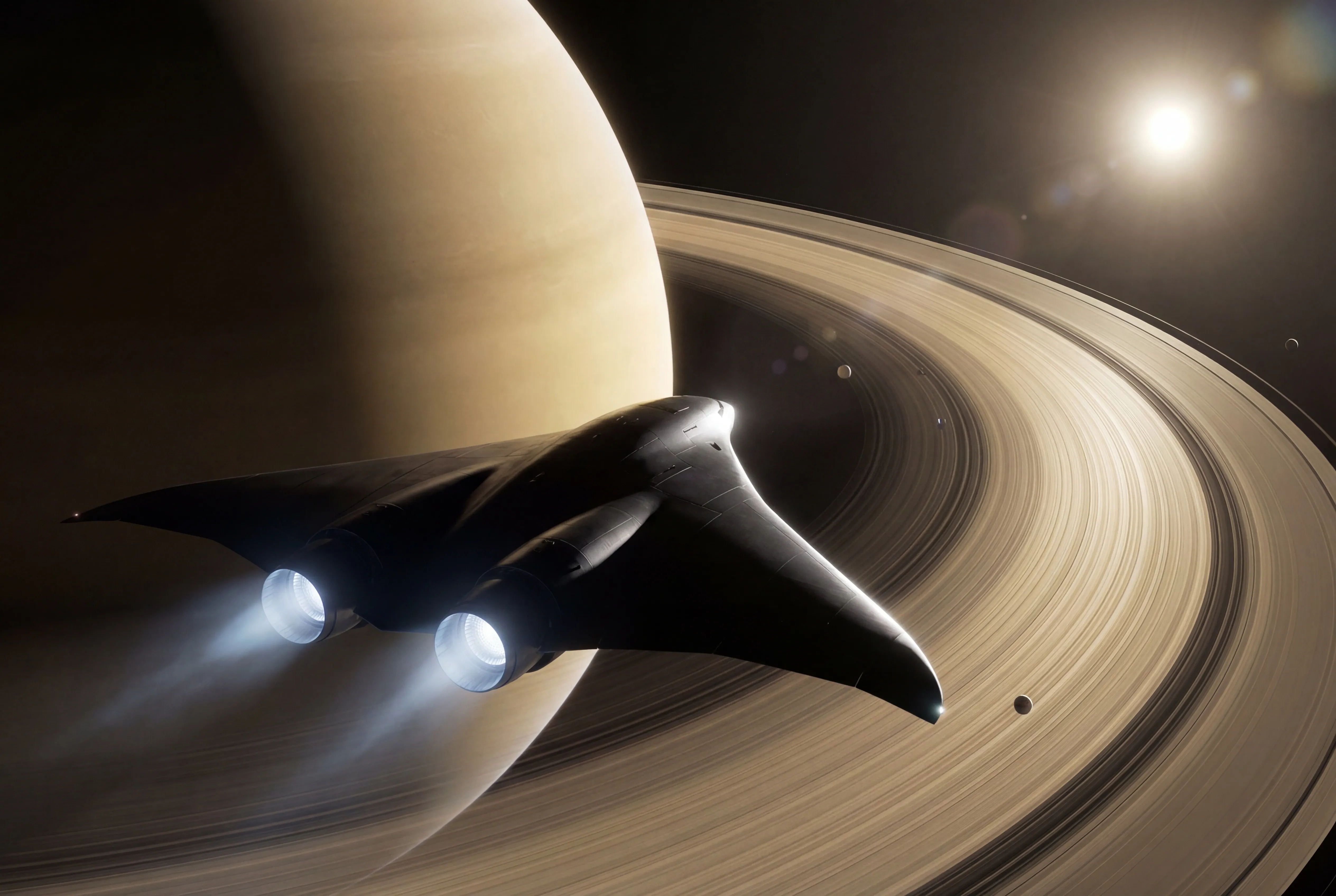
The Sun illuminates Saturn, light and shadow moving across the rings.
Imagine a ship falling towards it. It descends into the upper atmosphere, skims for fuel, then climbs away again. It has what it came for. It turns to the stars.
Call it Arcadia.
I. Where Humanity’s River Ends
Every spacecraft we have ever launched is a shipment.
But the distance from Earth to Alpha Centauri is 4.37 light-years. Supply chains don’t cross light-years. And every empire in human history was built on one.
The Solar Gravitational Lens showed that seeing no longer requires going.
The Free Starship shows the galaxy is traversable. It’s just not supplied.
II. A Ship Carries Its Own Harbour
A free starship behaves less like a payload and more like an organism.
Its freedom has three requirements:
Energy autonomy. Fusion is the minimum viable option, powerful enough to carry it past the Sun.[1]
Mass autonomy. The rocket equation still governs every burn. Refuelling stops one departure from carrying propellant for every journey that follows.
Operations autonomy. Modular components that can be swapped. Fabrication that can replace what breaks. Life support that can sustain a crew for decades.
III. From Worlds of Fuel
Fuel is abundant in our galaxy.
Jupiter holds roughly kilograms of deuterium: more than ten trillion of the essay’s largest modelled D–D propellant loads.[2][3][4] Roughly one star in ten hosts a gas giant.
There are entire planets of fuel dispersed across our galaxy.
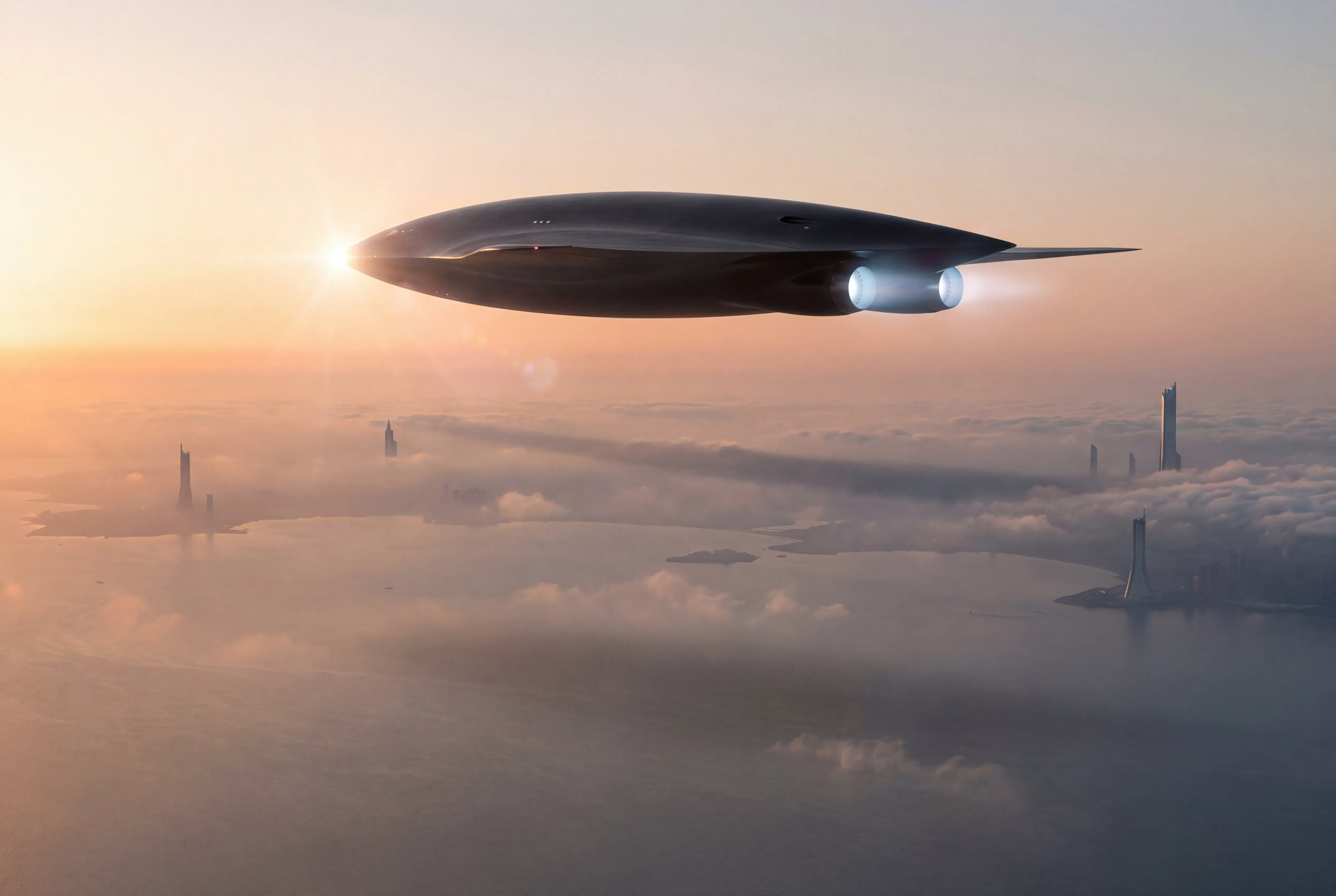
Descend into the upper atmosphere, skim fast, collect gas, separate the heavy hydrogen, climb away. The collection model gives a large craft tens of tonnes of deuterium per day.[3]
But throughput requires speed, and that requirement shapes Arcadia.
Its form must be wide and low: a lifting body generates aerodynamic lift at hypersonic velocity, holds together when air hits like a wall, and lets Arcadia run its intake.
Kilometre-scale radiator panels run its flanks, shedding the waste heat the reactor generates. The propellant tanks surround the crew habitat, serving as fuel storage and radiation protection.
IV. Saturn, Then the Stars
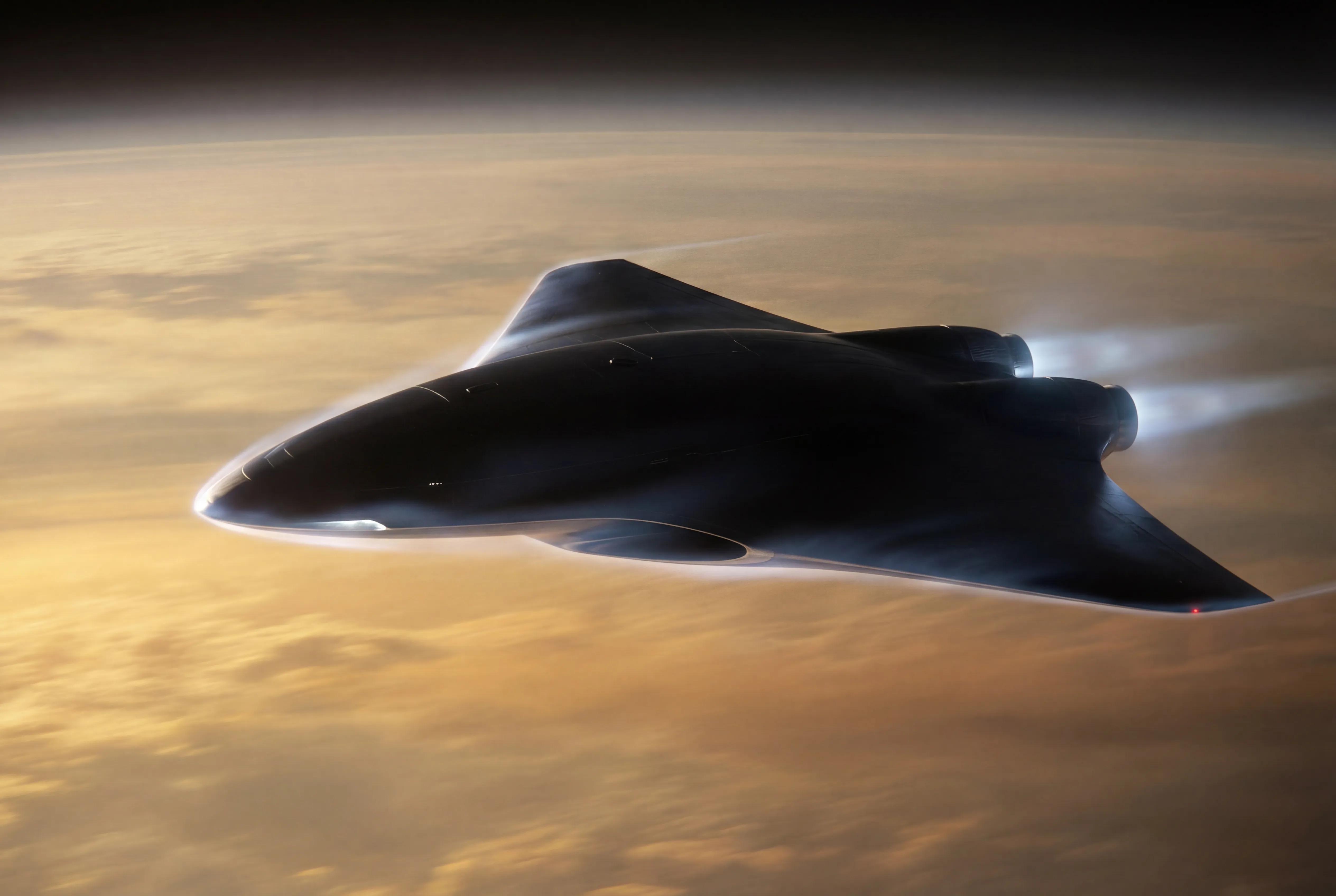
Earth first. If the vacuum lifting body closes structurally, buoyancy carries Arcadia through the dense lower atmosphere.[5][6] Stored propellant does the harder work from there: orbit, then Saturn (Appendix J).
This is the last leg where Arcadia requires Earth’s propellant.

Saturn next: a year or two at continuous low thrust. An established mining fleet fills Arcadia in parallel. At the appendix’s D–D collection rate, fifty miners need about three years.
The tanks fill. Earth’s fuel supply ends.
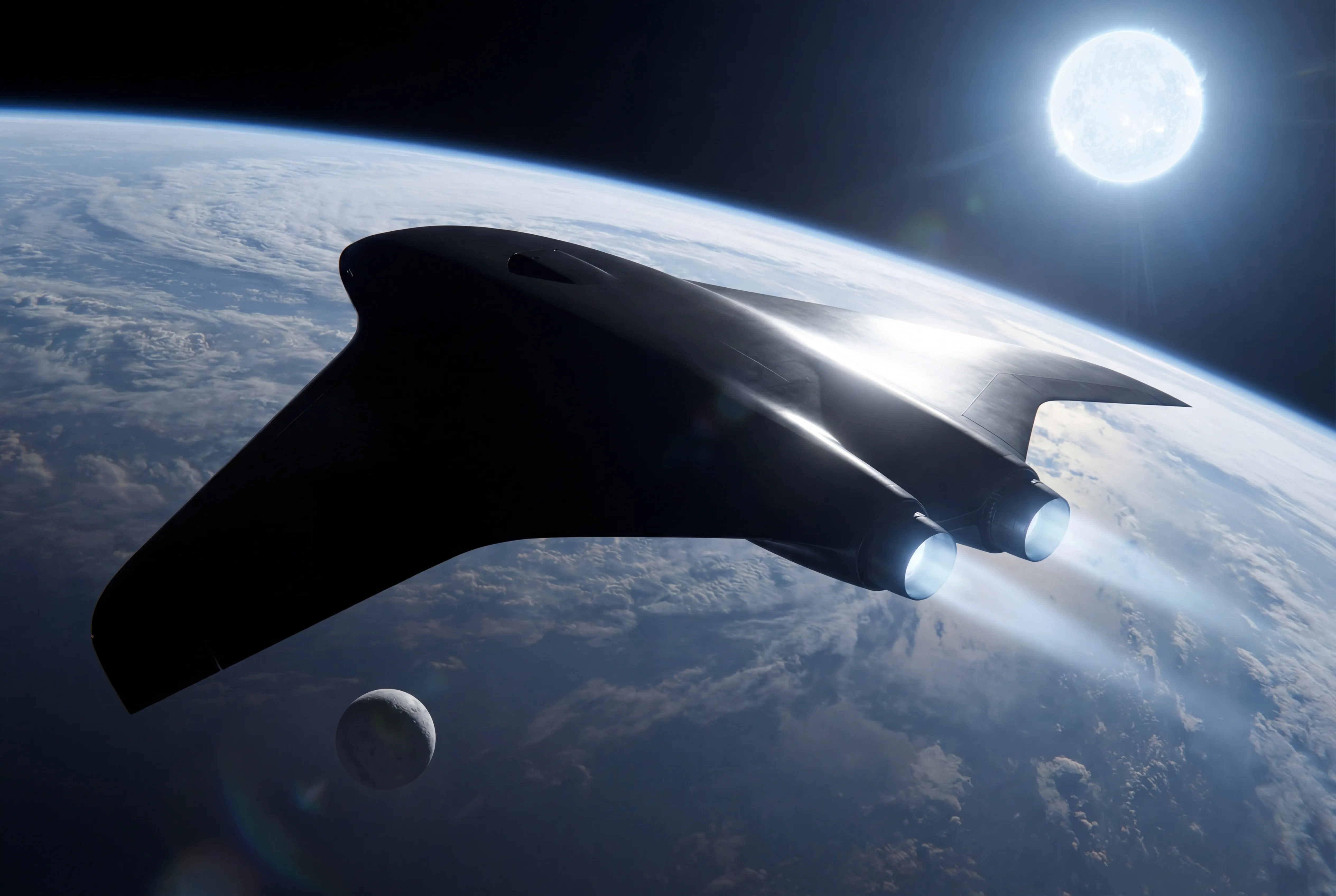
Then the propulsion reconfigures. The nozzle opens. The same fusion core that heated atmospheric gas now throws its own charged products aft through a magnetic nozzle, at thousands of kilometres per second.
At five per cent of the speed of light, the acceleration model puts Alpha Centauri about 111 years away: 24 years speeding up, 63 years coasting, 24 years slowing down. Interstellar gas and dust, harmless at walking speed, strike the forward hull like radiation. The design assumes induced torpor for most of the crew: the long sleep of hibernating mammals, extended to human lives.[7]
The ship decelerates into the destination system. It goes straight to the world already mapped.
The crew descends. Habitats go up. The planet comes into focus.
While the colony takes shape, the ship works autonomously.[8][9] Repeated passes through the local gas giant build propellant stores over decades. By the time the crew must decide, the fuel is there. Home, or further.
Refuelling turns distance into itinerary.
V. The Ship Becomes a Vessel
The universe kills spacecraft slowly, by attrition.
Seals crack. Sensors drift. Radiation degrades electronics. Thermal cycling fatigues metal, decade after decade. Freedom is healing: modular components that can be swapped, fabrication that can replace what breaks,[10] biological life support that can self-regulate for decades without resupply.[11]
Biology has maintained closed metabolic cycles for billions of years. Algae. Microbiomes. Hydroponic systems. So the same convergence of biotechnology, materials, and computing that is reshaping life on Earth becomes, aboard a free starship, a means of survival.
The ISS has demonstrated ~98% water recycling.[12][13] The mission needs 99%. Oxygen closure lags further: the ISS has demonstrated roughly 50%, against a mission target far higher.[14]
Mechanical parts, including pumps, seals, and structural panels, are plausible with additive and subtractive manufacturing from onboard feedstock. Metals can be reprocessed, polymers recast. But radiation-hardened processors, high-purity semiconductors, and precision sensors require fabrication chains that remain, today, firmly Earth-dependent.
The processors carried at departure set a mission clock. Radiation and thermal cycling wear them down, and nothing aboard can print more. How long the reserve lasts depends on shielding, redundancy, and use. Silicon is a countdown (Appendix K).
A colony inherits the clock. A crew of a hundred cannot labour a planet into industry. Machines mine, smelt, and print. The crew directs the work. Printers build refineries. Refineries feed foundries. The settlement must pull its first local wafer before the imported reserve fails.
Lose the sprint and the colony drops to a computing floor it can pour on site: fluidic logic in glass, thermionic logic in vacuum. Then it holds.
Humanity must design Arcadia to be, in the oldest sense of the word, a vessel.
VI. Waypoints Become Routes
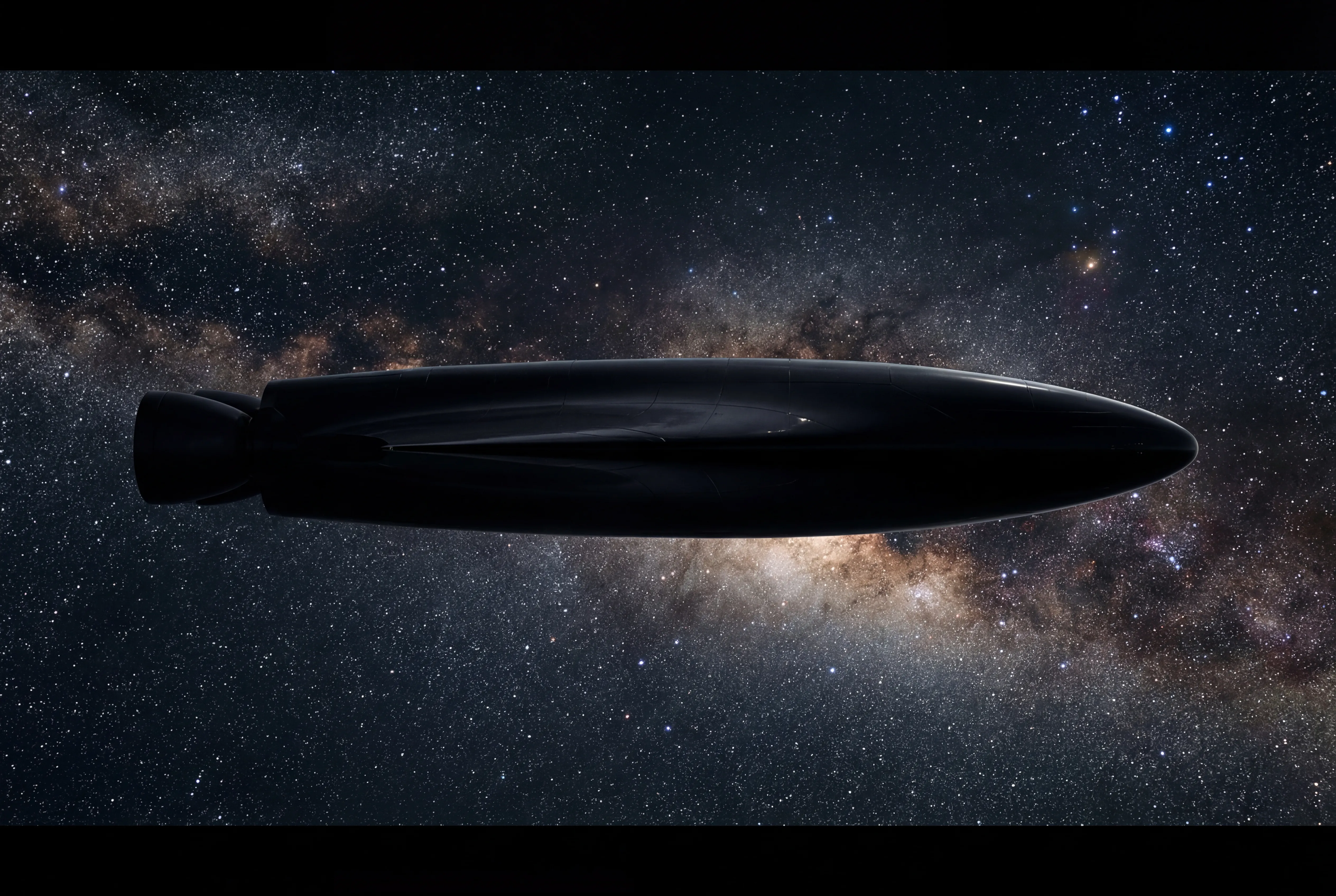
Each suitable gas giant offers another possible stop.
Arcadia hops between stars. Each hop is a human lifetime, spent mostly in sleep. Over centuries, a handful of ships becomes a lattice, because refuelling creates waypoints, and waypoints accumulate into routes, and routes become infrastructure.
The Solar Gravitational Lens would map destinations before Arcadia departs: continental geography, and perhaps chemical signs worth crossing space to investigate.[SGL]
And the lens works in both directions, because every star is one. After planetfall, Arcadia sends a single probe back out: a close fall past the new star for speed, then a quarter-century coast to its gravitational focus. From there, the star’s own gravity turns a metre of aperture into a permanent channel home (Appendix L).
The stream is one-way, and it arrives decades after planetfall. It shares geology, weather, perhaps even a discovery of alien life.
No ship that follows starts from zero.
VII. A Voyage Without Empire
Empires were built on logistics. Long-range travel required bases. Bases required control. Control became empire.
The supply chain was the empire.
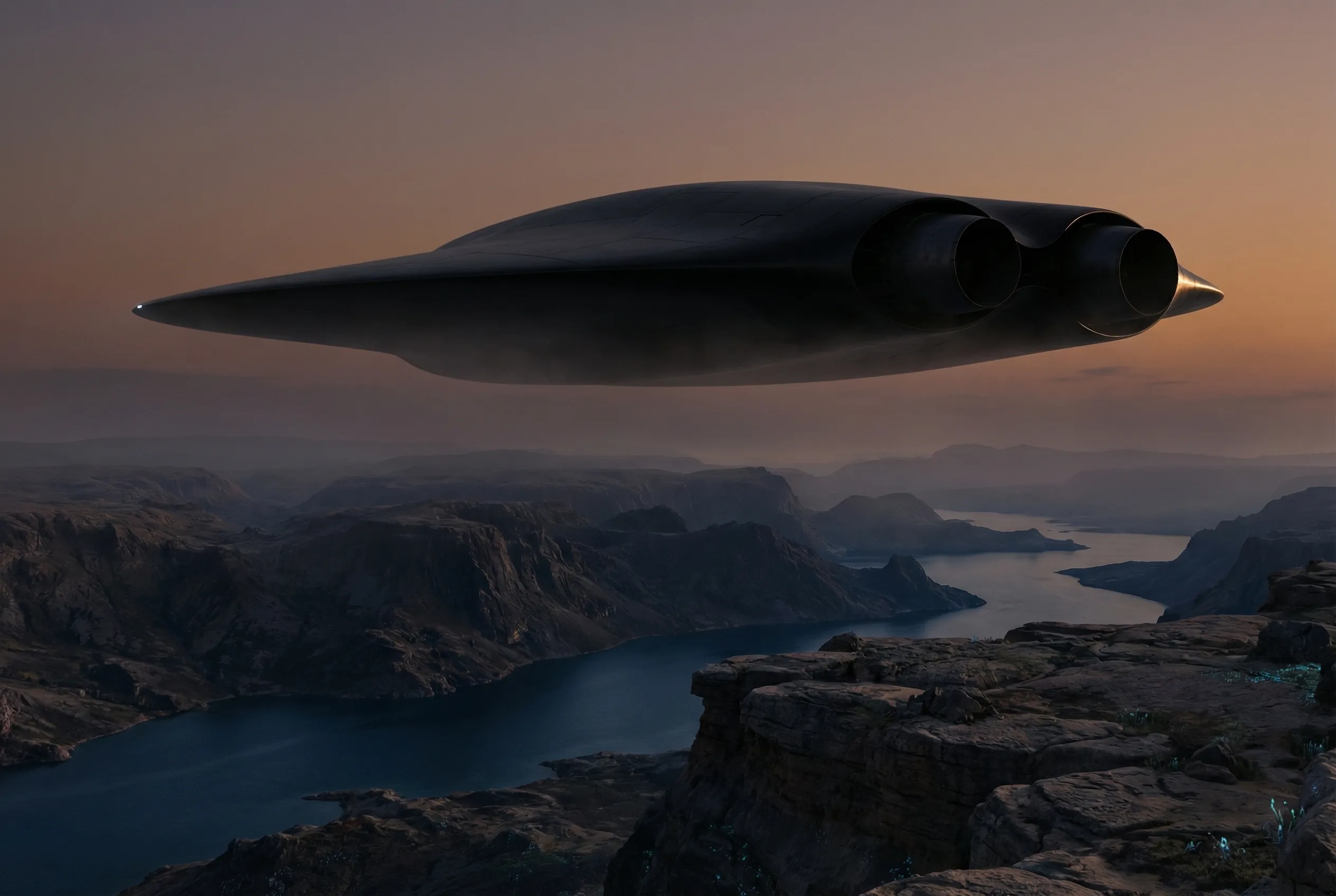
But a ship that supplies itself from gas giants does not need territorial control. It carries its own harbour.
What remains is Freedom.
VIII. The Map and the Vessel
The Solar Gravitational Lens showed that seeing no longer requires going.
The Free Starship shows that going no longer requires empire: the universe allows interstellar travel, and it charges a price—autonomy.
Build a ship that can refuel. Build a ship that can repair. Build a ship that can endure.
And the galaxy will never be far again.
Technical Appendix
Key calculations supporting quantitative claims in the essay body. Inline citations [1]–[27] and [SGL] map to the reference section below.
A. Kinetic Energy Budget
Chemical propulsion cannot approach this energy regime. Fusion is the minimum viable propulsion class for this mission.
For a 200,000-tonne spacecraft ( kg), translational kinetic energy scales quadratically with cruise speed:
| Cruise speed | (m/s) | (J) | ~Years of global electricity |
|---|---|---|---|
| 0.01c | ~9 | ||
| 0.02c | ~36 | ||
| 0.05c | ~225 |
Global electricity is ~ J/year.[15] A 10× reduction in dry mass reduces energy 10×. A 2× increase in cruise speed increases energy 4×. No chemical rocket reaches this energy regime.[16] Fusion is the minimum viable propulsion class capable of it.[17][1]
B. Deuterium Inventory
The Galileo probe measured Jupiter’s D/H ratio directly: .[2] The ±27% measurement uncertainty linearly scales deuterium yield estimates for any given processed mass flow. D/H varies by planet and depth. We use Jupiter here as a measured anchor for order-of-magnitude inventory.
Jupiter’s mass is kg, roughly 75% hydrogen by mass. The deuterium mass fraction of that hydrogen is , since a deuteron carries twice a proton’s mass (the same doubling used in Appendix D). Total deuterium:
Catalysed D-D fusion yield, where secondary products (tritium, He-3) are burned with additional deuterium, is approximately J/kg.[4] Plain D-D without secondary burn is lower (~ J/kg). This essay uses the catalysed figure throughout: the reactor architecture assumes secondary-product utilisation. Total available fusion energy from Jupiter’s deuterium alone:
C. Rocket Equation and Mass Ratio Analysis
The power scale that serves Solar System logistics cannot serve interstellar acceleration for this mass class.
The Tsiolkovsky equation:
For a 200,000-tonne dry-mass ship at (3,000 km/s):
| Comparable class | Propellant fraction (accel only) | Propellant fraction (accel + decel) | |
|---|---|---|---|
| 3,000 km/s | Lower bound direct product | 63.2% | 86.5% |
| 10,000 km/s | Daedalus-class direct product[18] | 25.9% | 45.1% |
At (6,000 km/s):
| Comparable class | Propellant fraction (accel only) | Propellant fraction (accel + decel) | |
|---|---|---|---|
| 1,000 km/s | Advanced plasma | 99.75% | ~100% |
| 3,000 km/s | Lower bound direct product | 86.4% | 98.2% |
| 10,000 km/s | Daedalus-class direct product | 45.1% | 69.9% |
The essay body uses 0.05c as cruise velocity. At (15,000 km/s):
| Propellant fraction (accel only) | Propellant fraction (accel + decel) | Propellant mass | |
|---|---|---|---|
| 10,000 km/s | 77.7% | 95.0% | 3,820,000 t |
| 15,000 km/s | 63.2% | 86.5% | 1,280,000 t |
At 0.05c with km/s the ship must carry 19× its dry mass in propellant to accelerate and then decelerate. That is the essay’s D–D reference case, loaded by a mining fleet (Appendix H). D–He3 exhaust at km/s reduces the ratio to ~6.4×, but replaces the mass problem with an isotope-supply problem.
Current fusion-electric drives (~100 km/s class) are excellent for Solar System logistics but cannot reach interstellar velocities without astronomical mass ratios. The two-tier architecture (Tier A fusion-electric for Solar System, Tier B direct fusion product for interstellar) reflects this constraint.
Deceleration at the destination is a drive burn against the direction of travel. The pre-departure fuelling campaign at the outer planets must load propellant for both the acceleration and deceleration legs. See Appendix H for loading timelines.
The power-thrust-time constraint. For any rocket where exhaust kinetic energy dominates: , where is thrust and is exhaust velocity. This creates a hard trade:
- High (good mass ratio) → low thrust per watt → long acceleration time
- Low (better thrust per watt) → poor mass ratio → enormous propellant fractions
At Tier A power scales (1–20 GW), pushing kg to 0.01–0.05c would take millennia.
Mode 3 power regime. In direct fusion product exhaust, thrust power is the kinetic energy of the fusion products: . In the D–D reference case, ship mass falls from about kg to kg across the two burns. Holding acceleration near 0.02 m/s² with m/s requires thrust power that falls from about 400 TW to 90 TW during acceleration, then from 90 TW to 20 TW during braking. Mode 3 spans tens to hundreds of terawatts.
Current quantified DFD-class designs report ~40 N thrust, ~56.5 km/s, and system specific power ~180 W/kg—firmly in Tier A.[19] Radiator mass, magnet mass, neutron damage, and power handling all scale non-linearly from multi-MW to multi-GW. Tier B remains a physics programme built on Tier A infrastructure.
Two distinct power regimes. The architecture requires separating two power classes that are often conflated:
- Hotel/industrial electrical power (MW–GW): life support, mining, manufacturing, station-keeping. This is the Tier A regime, compatible with NEP-like systems at specific mass 10–40 kg/kW.
- Propulsive fusion power (TW+): interstellar acceleration of a kg craft to 0.01–0.05c on sub-century timescales, driven by fusion product kinetic energy.
Near-term fission demonstrators (Kilopower-class) operate at single-digit W/kg. A “system-level ≥1,000 W/kg” target (≤1 kg/kW) is a leap of 1–2 orders of magnitude beyond current NEP design points. The architecture’s Tier A / Tier B split acknowledges this: Tier A is an engineering programme. Tier B is a physics programme that inherits Tier A infrastructure.
D. Atmospheric Intake and Throughput
Hypersonic skimming is not a design preference—it is forced by the throughput arithmetic.
The gross mass flow through the intake is . The dynamic pressure is . These two relations define the feasible skimming envelope. Throughput requires high , but structural survival limits :
| Regime | (kg/m³) | (km/s) | (kPa) | (kg/s) for m² |
|---|---|---|---|---|
| Deep/slow (1 bar level) | 0.2 | 2.0 | 400 | 4,000,000 |
| Mid-altitude (0.1 bar) | 0.02 | 3.0 | 90 | 600,000 |
| High/fast | 0.005 | 5.0 | 63 | 250,000 |
At kPa the structural loads are severe for a km-scale vehicle under repeated cycles. Operating at lower density (0.02–0.05 kg/m³) and higher velocity reduces to 60–100 kPa. That is within the envelope of high- hypersonic flight regimes, still punishing for repeated cycles at kilometre scale, and it costs instantaneous throughput. This is why the design trades where on the (, ) curve it operates: the remaining freedom is narrow, bounded above by structural limits and below by throughput requirements.[20]
Capture fraction and deuterium yield. The intake does not process all incoming flow. Define as the fraction of gross flow actually captured into the processing train, and as the net deuterium separation efficiency. The deuterium mass fraction of the hydrogen stream is ~ (from D/H , doubled for the mass ratio). Deuterium output per day:
where is the hydrogen mass fraction: approximately 0.76 for Jupiter in the hydrogen–helium approximation.[20] We use Jupiter’s measured D/H as an anchor. Saturn’s composition and vertical gradients may differ, shifting yield linearly.
For the mid-altitude case ( kg/s), with (5% capture) and (50% separation efficiency): t/day. At the deep/slow case with the same parameters: ~330 t/day. Appendix H uses 70 tonnes per day as its loading target. Even the mid-altitude case captures 30,000 kg/s of atmosphere, 250–1,000 times the 30–120 kg/s in the cited NASA studies. Capture drag, separation power, and plant mass remain the design work.[3]
At aerostatic speeds (100 m/s), mass intake drops by a factor of 20–50× versus hypersonic passes, making campaign durations impractical.
Saturn is the first practical refuelling stop. Its escape velocity is lower than Jupiter’s and its radiation environment far milder. Repeated sortie cycles cost less energy per kilogram of propellant recovered.[20]
E. Thermal Management
Radiator area from Stefan-Boltzmann:[21]
For 10 GW waste heat at 800 K (ideal blackbody): m² of emitting surface. Emissivity, view factors, sink temperature and radiation from one or both faces set the required panel area. Multi-megawatt NEP studies provide an areal-mass reference near 6 kg/m².[22] An illustrative 1–2 km² of panels at that density weighs 6,000–12,000 tonnes. Area and mass must use the same panel-face convention.
Radiator design is the primary structural fact of the spacecraft. At GW scale, two effects that are secondary at MW scale become first-order: micrometeoroid and dust damage to km²-class surfaces over decades, and integration of heat rejection geometry with propulsion exhaust and shielding. Liquid droplet radiators offer mass reduction at large areas but introduce containment/recapture complexity.[23]
Tier B coupling. If interstellar acceleration requires fusion power in the tens to hundreds of terawatts (Appendix C, Mode 3), then either the vast majority of that power must leave as directed exhaust energy with minimal waste heat fraction, or radiator area becomes implausibly large.
Mode 3 closes thermally only if most fusion energy leaves without striking the ship. D–He3 approaches that regime but is supply-limited. Catalysed D–D removes the isotope bottleneck, but roughly 38% of its reaction energy leaves in neutrons. Neutrons that escape carry energy away but damage structure on their path. Neutrons absorbed by shielding become heat. At tens to hundreds of terawatts, escape geometry, shielding, damage, and intercepted heat become the dominant architecture.[4]
F. Life Support Mass Balance
For a crew of 100, basic consumable throughput before recycling is approximately 215 tonnes per year (water ~110 t, oxygen ~33 t, food ~73 t). Applying a uniform 90%, 99% or 99.9% recovery assumption leaves roughly 22 tonnes, 2.2 tonnes or 220 kg to replace each year. The supply plan must close each material separately: harvested water and gases, regenerated food, and mineral-nutrient reserves. ISS has demonstrated ~98% water recovery with current ECLSS upgrades (Brine Processor Assembly).[12][24][13]
Oxygen closure is a harder bottleneck. NASA’s current state-of-the-art recovers ~50% of oxygen from exhaled CO₂ via Sabatier reduction.[14] The mechanism is structural: the Sabatier reaction produces methane (CH₄), which is currently vented overboard, losing four hydrogen atoms per carbon atom processed. Since water electrolysis depends on that hydrogen to regenerate O₂, venting methane caps maximum oxygen recovery at ~50% without post-processing.
Closing this loop further (toward ≥75–95%) requires cracking the methane to recover hydrogen—via pyrolysis, solid oxide electrolysis, or plasma decomposition—or bypassing the Sabatier entirely with biological photosynthesis. ESA’s MELiSSA programme is the most sustained effort toward near-complete closure using integrated bio-regenerative loops.[11]
The water gap to mission requirements is narrow. The oxygen gap is wider but tractable.
G. Transit Times
At Mode 3 conditions, the model uses acceleration of about 0.02 m/s². Reaching 0.05c takes:
Each 24-year burn covers about 0.60 light-years. Braking repeats the profile. The remaining 3.17 light-years take about 63 years at cruise. Total mission time is roughly 111 years. The same calculation at 0.02c gives roughly 228 years. Both require induced human torpor or a generational crew.[7] Velocity trades directly against thrust power and propellant requirements (Appendices C, H).
H. Propellant Loading Timelines
The propellant masses from Appendix C determine how long refuelling takes, and why the essay distinguishes Solar System mining (fleet architecture, parallelisable) from destination mining (single ship, sequential).
Pre-departure loading (Solar System, fleet-supported):
| Cruise velocity | Fuel and | Propellant required | Fleet of 20 ships at 70 t/day each | Fleet of 50 ships |
|---|---|---|---|---|
| 0.05c (accel + decel) | D–D, 10,000 km/s | 3,820,000 t | ~7.5 years | ~3 years |
Destination mining (single ship, return voyage):
| Return velocity | Fuel and | Propellant required | Single ship at 70 t/day |
|---|---|---|---|
| 0.02c (accel + decel) | D–D, 10,000 km/s | 464,000 t | ~18 years |
| 0.05c (accel + decel) | D–D, 10,000 km/s | 3,820,000 t | ~150 years |
Pre-departure loading in the Solar System is a fleet logistics problem solvable in years: purpose-built mining ships skim the gas giants in parallel and transfer propellant to Arcadia on intercept. This uses the fleet logic of NASA AMOSS at the higher target rate modelled here.[3]
At the destination, the ship mines alone. A D–D return voyage at 0.02c requires about 18 years of mining. A 0.05c departure requires about 150. Speed becomes a choice about waiting.
He-3 bottleneck. D-He3 propulsion at km/s requires helium-3, which is present at trace levels. Galileo measured in Jupiter’s atmosphere.[2] NASA AMOSS studies quantify the throughput directly:[3]
| Target He-3 mass | At 30 kg/s processing | At 120 kg/s processing |
|---|---|---|
| 50 t | ~1,270 days (~3.5 years) | ~317 days (~0.9 years) |
| 100 t | ~2,540 days (~7 years) | ~634 days (~1.7 years) |
| 10,000 t | ~254,000 days (~696 years) | ~63,400 days (~174 years) |
These figures assume linear scaling from the NASA reference case and continuous operations. He-3 as the dominant propellant for a -tonne-class fuel load implies millennial campaigns unless parallelised massively (fleet mining) or sourced from richer sites.
Saturn’s atmospheric helium is depleted by H/He phase separation (“helium rain”), with estimated He mass fraction ~0.13–0.16. Uranus and Neptune preserve higher primordial helium fractions and may offer better He-3 yield per kilogram processed, trading lower gravity wells and longer transit against improved isotope recovery.
Isotope separation. Helium isotope separation at scale requires cryogenic methods—distillation, cryogenic adsorption, or superfluid “heat-flush” techniques—each with distinct temperature, equipment mass, and throughput characteristics. Hydrogen isotope separation (H/D) uses mature cryogenic distillation. In space, the challenges are long-duration cryogenics maintenance and contamination control.
Propellant strategy fork. The choice of fusion fuel regime determines the interstellar architecture:
- D-He3 dominant ( km/s): best mass ratio, low neutron flux, but gated by He-3 industrial throughput: fleet mining or millennial single-ship campaigns. The supply chain is the constraint.
- D-D catalysed (– km/s): worse mass ratio and higher neutron load (first-wall lifetime, shielding), but eliminates the He-3 dependency entirely. Deuterium is abundant and extraction is straightforward.
This is the single biggest architectural fork in the system. D-He3 buys performance at the cost of industrial complexity. D-D buys simplicity at the cost of propellant mass and neutron management. A practical architecture may use both: D-He3 where He-3 is available from fleet-supported Solar System mining, D-D as the fallback at destination systems where only the ship itself is mining.
I. Radiation Environment and Interstellar Cruise Hazards
Galactic cosmic ray dose. MSL/RAD measurements during Mars cruise provide the best empirical deep-space analogue: dose equivalent rate of 1.84 ± 0.3 mSv/day (~0.67 Sv/year).[25] NASA-STD-3001 Vol 1 Rev B sets a universal career effective dose limit of 600 mSv.[26] An indefinite mission exceeds this limit within the first year at unshielded cruise conditions, making radiation management structurally load-bearing.
Passive shielding complication. Adding passive mass reduces low-energy GCR but can create secondary particle cascades from high-energy HZE ions. Partial shielding can worsen some dose components. The practical architecture separates SPE protection, amenable to storm shelters and local passive mass, from chronic GCR/HZE exposure, which requires large column density, active magnetic deflection, or both.
Active magnetic shielding. NASA NIAC work on spacecraft-scale magnetospheric protection proposes dipolar torus topologies to deflect a large fraction of GCR including HZE. Deflection of a GeV proton requires on the order of ~3 T·m. The approach introduces new failure modes: cryogenics, quench protection, structural loads. Net benefit must be assessed with full particle transport, including secondaries.[27]
Interstellar medium impacts. At 0.01–0.05c, collisions with interstellar gas and dust become a distinct hazard class not captured by GCR shielding alone. Even atomic hydrogen at 0.05c carries ~1.2 MeV/nucleon. Over decades of cruise, cumulative damage modes include surface erosion, gas implantation and blistering, and rare catastrophic dust grain impacts. Forward shielding design, erosion-resistant coatings, and a sacrificial leading-edge architecture are engineering requirements for Tier B, separate from and additional to the radiation shielding problem.
J. Buoyant Ascent
Displacement requirement. To buoy kg in sea-level air requires displacing roughly m³, a volume about 550 m on a side. Not absurd for a lifting body at this scale. The hull is a shell whose mean density is below ambient air, held open by structural stiffness rather than internal gas pressure.
Failure modes. The dominant failure mode is buckling under external pressure, not weight. Shell stability, puncture tolerance, and inspectability are the engineering constraints, not material density alone.
This is a conjectural subsystem, not a closed design. Low mean density is necessary but insufficient. The architecture still needs a shell-mass and buckling solution at one atmosphere, puncture tolerance, and a complete ascent delta-v budget.
K. The Silicon Clock
Structure can be printed from a planet. Processors cannot.
Scope. This appendix sets out a proposed industrial sequence for the colony. Component lifetimes and the time needed to build a local semiconductor industry remain to be modelled.
The bounded currency. A settlement scales structural mass locally: regolith to metal, silicates to glass, both to enclosures. Nanoscale semiconductors do not scale the same way. A modern fab sits at the top of a supply chain of thousands of firms working the purest materials humans make. What the ship lands with is a fixed inventory: flight processors, sensors, radios, and spares. Total ionising dose, thermal cycling, and single-event burnout retire it. Qualification data can bound that attrition, but this appendix does not derive a fleet-wide lifetime. Imported silicon is a finite inventory. That inventory is the mission clock.
The ladder. The imported seed tools—metal printers, CNC mills, sintering beds—are selected for transitivity: each must be able to build a larger, cruder version of itself and the next tool up. The sequence runs from refining and induction smelting, through local generation and high-purity chemistry, to lithography: contact printing first, at micron scale, then projection steppers, then deep-ultraviolet optics. Parity with Earth is not the goal. A colony runs indefinitely on 1980s-class silicon if it can make enough of it. The sprint is from planetfall to the first local wafer, before the imported reserve fails.
The floor. If lithography slips past the clock, the settlement drops one technological register and survives. Homeostasis—airflow, water, nutrient dosing in the agricultural enclosures—runs on fluidic logic cast into the structural ribs: no semiconductors, no radiation sensitivity, printable in glass and alloy. Heavy automation runs on thermionic vacuum-tube relays at macro scale. The floor is stagnation, not collapse, and it preserves the chemistry and optics work that makes a second attempt possible.
The administrators. The scarcest resource is crew attention: a hundred people supervising a planetary industrial birth. The architecture is federated. Each sector—refining, agriculture, logistics—runs autonomously at the edge, on the cheapest substrate sufficient for it, and reports summaries upward to a shielded mainframe vault. Imported silicon is reserved for what only silicon can do: design, sequencing, the vault itself. The crew does not operate machines. It adjudicates exceptions. This is the deployment shape Computational Abundance describes on Earth—bounded autonomy at the edge, verification at the centre—run where the stakes are a settlement rather than a workflow.
L. The Reverse Relay
Every star ships with its own telescope.
Register. Like Appendix K: design modelling on published physics.
Geometry. The lens of The Solar Gravitational Lens is not unique to the Sun. Any star bends light the same way, and a Sun-like star focuses from roughly 550 AU outward.[SGL] After planetfall, one probe makes the lens mission in reverse: a close pass by the new star for velocity—the Sundiver manoeuvre—then an outbound coast of roughly 25 years to the focal line, buffering the survey record on solid state as it goes: geology, atmospheric chemistry, biology sequenced in the field.
The link. On station, the probe transmits along the Earth line, and the host star’s gravity supplies the gain—the same ~10¹¹ amplification the lens essay describes, now working for the transmitter. Metre-class apertures at both ends close an optical link across tens of light-years. The receiver is an SGL station already parked on the Sun’s focal line, pointed the right way: the instrument that mapped the destination now listens to it.
The lattice. Latency equals distance. A colony thirty light-years out speaks with a thirty-year delay, permanently, and the link is a broadcast, not a conversation. What it carries compounds anyway: every manifest, alloy, and enclosure design in the next wave of ships is corrected by ground truth from the last, decades before launch. Each settled system adds a node. The ships carry the species outward. The lenses carry what it learns home.
M. Falsifier Register
A century-scale programme cannot be dated the way a market can. These gates are the observables that come first, and what each one breaks.
M.1 — Fusion at flight weight, at the first commercial generation. The essay stakes energy autonomy on fusion as the minimum viable propulsion class (Appendix A). The gate is not ignition. It is specific power: confinement mass must fall until a reactor can push its own weight. If the first generation of commercial fusion plants shows confinement mass refusing to fall—power plants that work only as buildings—Tier A slips a generation and Tier B waits on physics this essay does not claim.
M.2 — Closure, at the stations that replace the ISS. The ISS has demonstrated ~98% water recycling and roughly 50% oxygen closure; the mission needs 99% and far higher (Appendix F). The next generation of stations publishes its closure numbers. If they do not pass the ISS’s, “decades without resupply” fails and the vessel remains a shipment.
M.3 — Torpor, at the first sustained human trials. The crossing assumes most of the crew sleeps (Appendix G).[7] If induced human torpor stalls at hours and days rather than weeks and months, life-support mass budgets inflate and the long night becomes a crewed century: a generational ship, a different and harder book.
M.4 — The silicon clock, checkable against qualification data. Appendix K treats imported silicon as a finite inventory. Radiation-hardened component lifetimes are published qualification data today. A fleet-wide attrition model must combine them with shielding, duty cycle, cold reserve, repair, and redundancy. Until that model exists, the clock has no honest number.
M.5 — The reverse relay inherits the lens’s physics. Appendix L shares the corona, station-keeping, alignment, and link-budget gates of The Solar Gravitational Lens. Image reconstruction is irrelevant to communication. If the link budget fails, the lattice loses its relays but keeps its ships.
References
Numbered in order of first citation. [1]–[27] and [SGL] are cited in the body and appendices. Uncited background references follow the primary list.
[1] Long, K.F. (2012). Deep Space Propulsion: A Roadmap to Interstellar Flight. Springer-Praxis. (Survey of propulsion classes from fission to fusion to beamed energy.)
[2] Mahaffy, P.R. et al. (2000). “Noble Gas Abundance and Isotope Ratios in the Atmosphere of Jupiter from the Galileo Probe Mass Spectrometer.” JGR: Planets 105(E6). (The measured D/H and ³He/⁴He ratios anchoring the fuel-inventory estimates.)
[3] Palaszewski, B. (2020). “Atmospheric Mining in the Outer Solar System: Aerospacecraft Analysis, Propulsion, and Resource Capturing Implications.” NASA Glenn Research Center / AIAA Propulsion and Energy Forum. See also Palaszewski, B. (2024). “Atmospheric Mining in the Outer Solar System: Interplanetary Transfer Vehicles, In-Situ Resource Utilization, and Moon Mining Issues.” NASA Technical Reports Server. (Atmospheric mining of deuterium and helium-3 from outer-planet atmospheres, including capture rates, storage, and in-situ utilisation.)
[4] Atzeni, S. & Meyer-ter-Vehn, J. (2004). The Physics of Inertial Fusion. Oxford University Press. (Reaction energetics for D-D, D-T, and D-He3 channels.)
[5] Sun, H. et al. (2013). “Ultralight Graphene Aerogel.” Advanced Materials 25. (Densities as low as ~0.16 mg/cm³—the material class behind a hull lighter than air.)
[6] Gibson, L.J. & Ashby, M.F. (1999). Cellular Solids: Structure and Properties (2nd ed.). Cambridge University Press.
[7] Cerri, M. et al. (2013). “Hibernation for space travel: Impact on radioprotection.” Life Sciences in Space Research 1(1). See also Bradford, J. et al. (2018). “Torpor Inducing Transfer Habitat for Human Stasis to Mars.” NASA Technical Reports Server; and Bradford, J. et al. (2018). “Advancing Torpor Inducing Transfer Habitats for Human Stasis to Mars: II - Phase.” NASA Technical Reports Server.
[8] Frank, J., Jónsson, A., Morris, R. & Smith, D. (2001). “Planning and Scheduling for Fleets of Earth Observing Satellites.” NASA Technical Reports Server / i-SAIRAS. (Autonomous planning and scheduling for spacecraft fleets.)
[9] Muscettola, N., Nayak, P.P., Pell, B. & Williams, B. (1998). “Remote Agent: To Boldly Go Where No AI System Has Gone Before.” Artificial Intelligence 103(1–2). (Flight-validated on Deep Space 1 in 1999: goal-based commanding and autonomous fault recovery.)
[10] Prater, T.J. et al. (2019). “3D Printing in Zero G Technology Demonstration Mission: Complete Experimental Results and Summary of Related Material Modeling Efforts.” International Journal of Advanced Manufacturing Technology 101, 391–417. (The ISS Additive Manufacturing Facility, installed April 2016—in-space fabrication demonstrated.)
[11] ESA. “MELiSSA (Micro-Ecological Life Support System Alternative).” See also the MELiSSA Foundation. (Integrated bio-regenerative life support targeting near-complete closure.)
[12] Anderson, M.S. et al. (2018). “Life Support Baseline Values and Assumptions Document.” NASA/TP-2015-218570 Rev 1. (The standard per-crew consumable throughput figures used in Appendix F.)
[13] Williamson, H. & Wilson, M. (2023). “Status of ISS Water Management and Recovery.” Proceedings of the 53rd International Conference on Environmental Systems (ICES-2023). NASA NTRS. BPA milestone: ~98% total water recovery from urine brine.
[14] NASA SpaceCraft Oxygen Recovery (SCOR) project. “SpaceCraft Oxygen Recovery (SCOR).” See also NASA TechPort: “SpaceCraft Oxygen Recovery.” ISS oxygen recovery from exhaled CO₂ is limited by the Sabatier loop and hydrogen loss through methane byproduct. See also Knox, J.C. et al. (2015). “Development of Carbon Dioxide Removal Systems for Advanced Exploration Systems.” NASA/TM-2015-218825.
[15] International Energy Agency. World Energy Outlook. (Global electricity production ~10²⁰ J/year—the yardstick in Appendix A.)
[16] Sutton, G.P. & Biblarz, O. (2017). Rocket Propulsion Elements (9th ed.). Wiley. (The standard reference for chemical propulsion’s performance ceiling.)
[17] Wurden, G.A. et al. (2016). “Magneto-Inertial Fusion.” Nuclear Fusion 56(11), 116007. (The compact, high-density fusion class assumed for Arcadia’s reactor.)
[18] Bond, A., Martin, A.R. & Project Daedalus Study Group (1978). “Project Daedalus: The Final Report on the BIS Starship Study.” JBIS (Special Supplement). (The reference design for direct fusion product exhaust at ~10,000 km/s.)
[19] Razin, Y.S. et al. (2014). “A Direct Fusion Drive for Rocket Propulsion.” Acta Astronautica 105(2). See also Cohen, S.A. et al. (2019). “Direct Fusion Drive for Interstellar Exploration.” JBIS 72(2), 37–50. Open PDF: PPPL copy. Reference design: ~40 N thrust, ve ~56.5 km/s, system specific power ~180 W/kg.
[20] NASA Science / JPL Solar System Dynamics. “Jupiter Facts.” “Saturn Facts.” See also JPL Solar System Dynamics: “Planetary Physical Parameters.” For the hydrogen–helium mass basis, Taylor, F.W. et al., “The Composition of the Atmosphere of Jupiter,” Table 4.6. Galileo’s helium mass fraction is approximately 0.238; molecular volume fractions use a different basis. Atmospheric composition, gravity, escape velocity, and planetary physical parameters used for gas-giant comparison and refuelling-envelope estimates.
[21] NIST. “Fundamental Physical Constants: Stefan–Boltzmann Constant.” ( W·m⁻²·K⁻⁴, used in Appendix E.)
[22] Machemer, W.T. & Duchek, M.E. (2023). “Considerations for Radiator Design in Multi-Megawatt Nuclear Electric Propulsion Applications.” Nuclear Technology 209(sup1). (Representative radiator areal density ~6.1 kg/m² and view factor ~0.73.)
[23] Mattick, A.T. & Hertzberg, A. (1981). “Liquid Droplet Radiator Performance and Design.” Journal of Energy 5(6), 387–393. (The lower-mass alternative for large radiating areas.)
[24] National Academies (2011). Recapturing a Future for Space Exploration: Life and Physical Sciences Research for a New Era. (Decadal survey framing of closed-loop life support research priorities.)
[25] Zeitlin, C. et al. (2013). “Measurements of Energetic Particle Radiation in Transit to Mars on the Mars Science Laboratory.” Science 340(6136). (Cruise dose equivalent 1.84 ± 0.3 mSv/day—the deep-space baseline in Appendix I.)
[26] NASA. “NASA Spaceflight Human-System Standard Volume 1: Crew Health.” NASA-STD-3001_VOL_1. NASA-STD-3001 Volume 1 establishes crew-health requirements for human spaceflight, including radiation exposure limits.
[27] Bamford, R.A. et al. (2014). “An Exploration of the Effectiveness of Artificial Mini-Magnetospheres as a Potential Solar Storm Shelter for Long Duration Human Space Missions.” Acta Astronautica 105(2), 385–394. Repository record: University of Strathclyde. See also Westover, S.C. et al. (2014). “Magnet Architectures and Active Radiation Shielding Study - SR2S Workshop.” NASA Technical Reports Server.
[SGL] Turyshev, S.G., Shao, M., Toth, V.T. et al. (2020). “Direct Multipixel Imaging and Spectroscopy of an Exoplanet with a Solar Gravitational Lens Mission.” arXiv:2002.11871. See also Turyshev, S.G. (2024). “Gravitational lensing for interstellar power transmission.” Physical Review D 109, 064029. (Optical gain ~10¹⁰–10¹¹ at the focal line—the companion essay’s mission reference.)
Background references
Slough, J., Kirtley, D. & Weber, T. (2019). “Fusion-Driven Rocket Propulsion.” NASA NIAC Phase II Report. https://ntrs.nasa.gov/citations/20190027571
ITER Organization. “Fusion Fuel: Deuterium and Tritium.” https://www.iter.org/sci/FusionFuels
Bussard, R.W. (1960). “Galactic Matter and Interstellar Flight.” Astronautica Acta 6. https://ui.adsabs.harvard.edu/abs/1960AcA…6..179B/abstract
NASA Human Research Program. “Space Radiation Risk.” https://humanresearchroadmap.nasa.gov/Risks/risk.aspx?i=69
NASA. “Environmental Control and Life Support System (ECLSS).” https://www.nasa.gov/reference/eclss/
Eckart, P. (1996). Spaceflight Life Support and Biospherics. Springer. https://link.springer.com/book/10.1007/978-94-011-0585-4
NASA OSAM (On-orbit Servicing, Assembly, and Manufacturing). https://www.nasa.gov/mission/osam-1/
Peng, B. et al. (2008). “Near-Ultimate Strength for Multiwalled Carbon Nanotubes.” Nature Nanotechnology 3, 626–631. https://doi.org/10.1038/nnano.2008.211
NASA In-Situ Resource Utilisation (ISRU) Strategy. https://www.nasa.gov/isru
Smil, V. (2017). Energy and Civilization: A History. MIT Press.
Forward, R.L. (1984). “Laser-Pushed Lightsails.” Journal of Spacecraft and Rockets 21(2). https://doi.org/10.2514/3.8632
Breakthrough Starshot. https://breakthroughinitiatives.org/initiative/3
NASA Innovative Advanced Concepts (NIAC). https://www.nasa.gov/niac/
MIT Plasma Science and Fusion Center. https://www.psfc.mit.edu/
Jenett, B. et al. (2020). “Digital Morphing Wing: Active Wing Shaping Concept Using Composite Lattice-Based Cellular Structures.” Soft Robotics 4(1). See also: NASA vacuum airship feasibility using architected lattice materials—strength-limited rather than buckling-limited.
Hyers, R.W. (2012). “High-Temperature Space Radiator Materials.” In Encyclopedia of Thermal Packaging. World Scientific.
Juhasz, A.J. “Design Considerations for Lightweight Space Radiators Based on Fabrication and Test Experience with a Carbon-Carbon Composite Prototype Heat Pipe.” NASA. https://ntrs.nasa.gov/citations/19980236936. PDF: https://ntrs.nasa.gov/api/citations/19980236936/downloads/19980236936.pdf
Bamberger, H., Cimino, P.J. & Stiffler, S.R. (2015). “Review of Helium Isotope Separation Techniques.” Covers cryogenic distillation, adsorption, and superfluid superleak/heat-flush methods for He-3/He-4.
Spillantini, P. et al. (2007). “Magnetic Shielding of Astronauts from Cosmic Rays.” Nuclear Instruments and Methods in Physics Research B252. ESA active shielding study: viable only with advanced superconducting technology.
Palaszewski, B. (2020). “Atmospheric Mining in the Outer Solar System: Resource Capturing, Storage, and Utilisation.” AIAA/JPC 2020. Updated capture-rate benchmarks for He-3 throughput.
Turyshev, S.G. & Toth, V.T. (2020). “Photometric Imaging with the Solar Gravitational Lens.” Physical Review D 101(4). https://doi.org/10.1103/PhysRevD.101.044025
Our World in Data. “Electricity Mix.” https://ourworldindata.org/electricity-mix