The Solar Gravitational Lens
Photographing distant worlds by turning the Sun into a telescope.
Imagine a spacecraft hanging far beyond Pluto, fourteen times its distance from the Sun. Around the Sun, in its glare, the craft finds a thread-thin ring of light, an image encoded in gravity.
Over months, a world resolves.
I. Turning the Sun into a Telescope
The Sun has been bending starlight for billions of years. And in that bending is a telescope we’ve never been able to reach.
Einstein finished general relativity in 1915[1]: matter shapes spacetime, and spacetime shapes motion.
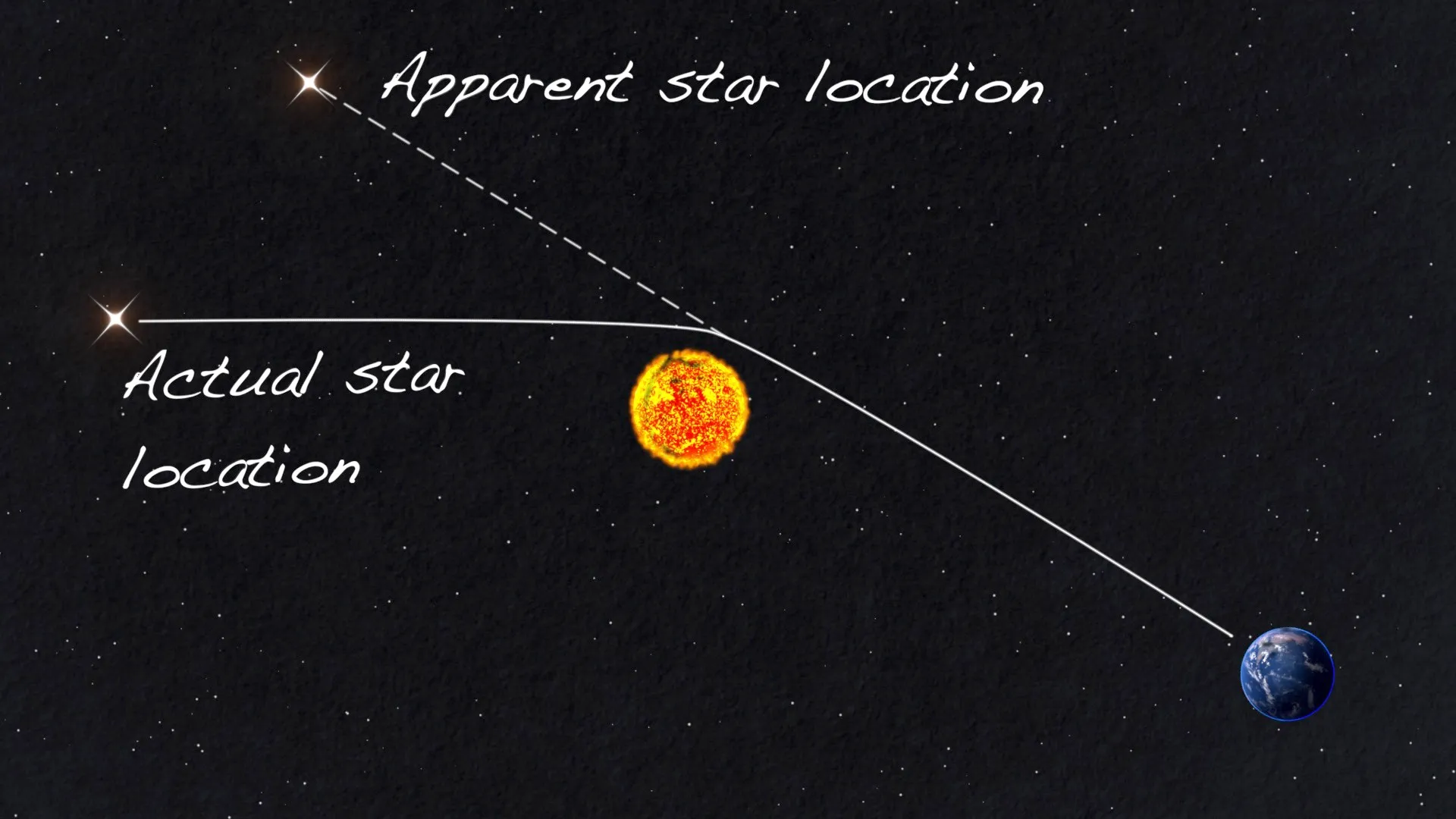
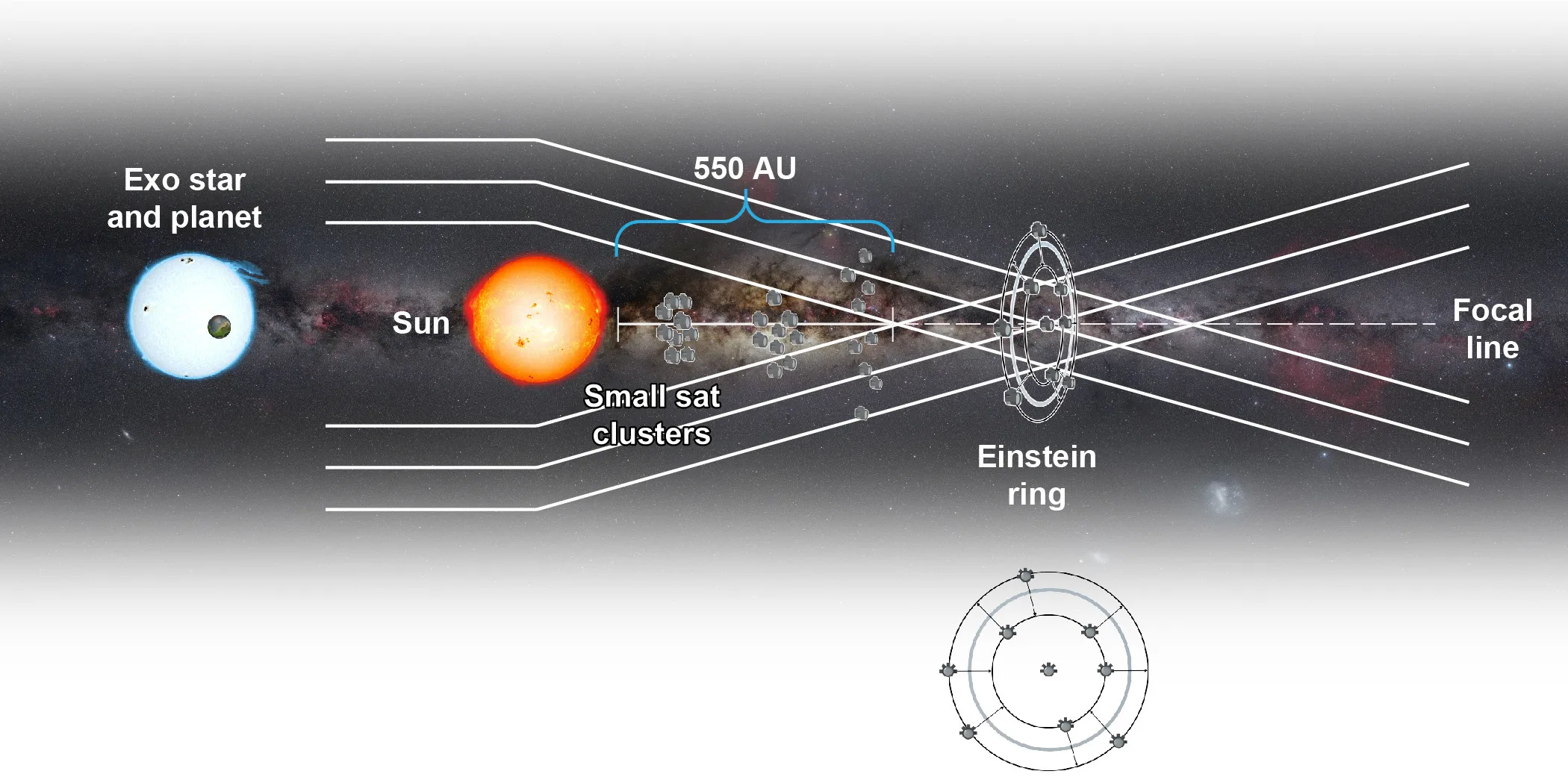
Light also traces the curvature of spacetime. Rays skimming the Sun are curved, which creates a long focal line[2]. For rays at the solar edge, the focal line begins around 547 AU, roughly fourteen times Pluto’s distance, and continues outward. Unlike a glass lens, the Sun’s gravity doesn’t focus to a point, but along a line. In 1979, physicist V.R. Eshleman named what it had always been: a telescope.[3]
A Continent Through a Metre of Mirror
At visible wavelengths, the Solar Gravitational Lens (SGL) can amplify light by a factor of ~10¹¹ near the optical axis[4]. One metre of mirror. Fourteen times Pluto’s distance. A continent, resolved, on a world a hundred light-years away.
Matching this resolution with a conventional interferometer requires baselines hundreds of kilometres wide. The Sun already spans that.
II. Cosmic Cartography
Perceptual Abundance followed the instruments that made the universe visible. Exoplanets mark a limit we have yet to cross.
We’ve confirmed thousands of exoplanets. We know their sizes, orbits, and something of their atmospheres. We can infer whether a world is temperate. We can detect carbon dioxide in its air.
The Solar Gravitational Lens would turn an Earth-like planet from a point of light into a place we can map.
From Pixels to Geography
The SGL reconstructs worlds with light and computation.
What arrives is an Einstein ring: every point on it contains a blurred contribution from much of the planet’s disk. The spacecraft steps laterally through the focal region, records how the ring’s brightness shifts at each position, and builds a dataset. Then reconstruction inverts that dataset into a map.
It’s closer to medical imaging than photography.
The physics is the instrument. Computation is the camera.
A one-metre telescope near 650 AU could reconstruct continents on an Earth-like world a hundred light-years away. A 2026 simulation recovered features roughly two hundred kilometres across; the mission studies explore what finer maps would take.[4] [5] [6]
You could see geography. A slow reveal: continents, cloud systems, bright ice, assembled over months of light and computation. The marks of a world still changing, or one long frozen in place.
III. Reaching the Sun’s Distant Focus
A Generation to Reach the Lens
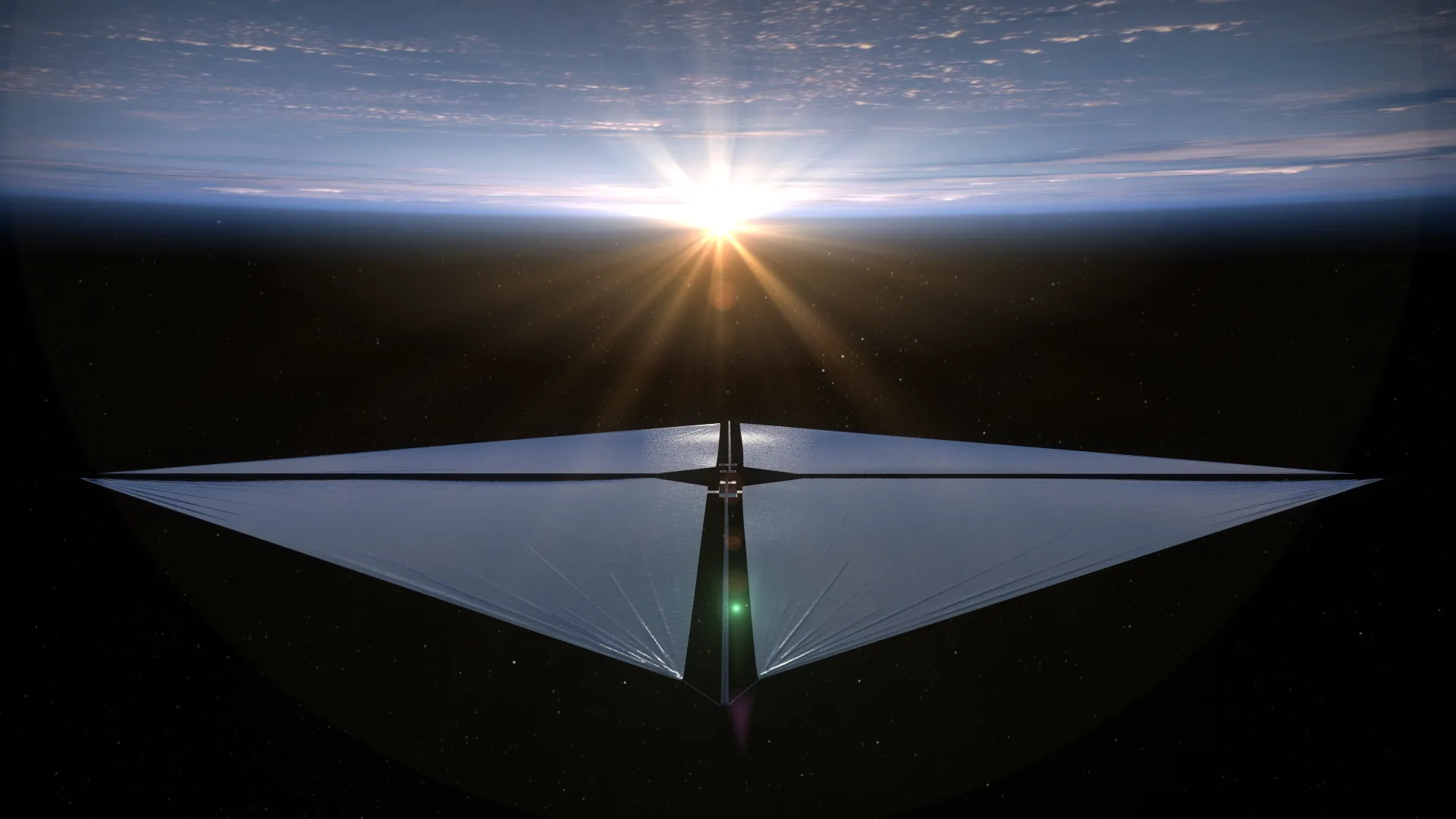
547 AU is far. Pluto orbits at roughly 40 AU. Voyager 1, launched in 1977, is still short of 550 AU[7]; at its pace, the focal line is more than a century away. Proposed solar sails would dive close to the Sun to gain speed. Laser propulsion could push faster still.[8][9][10] The mission designs aim for 15–25 years.
Holding a Moving World in Focus
Navigation is the central operating problem. At 30 parsecs, the projected Earth is only about 1.3 kilometres wide in the image plane. The craft must know where it is within that moving plane while the planet, its star, and the Sun all move. Ion thrusters provide control. Metrology provides the map.
SGL imaging is computational astronomy. The inverse methods exist. The open test is whether they recover stable geography through photon noise, corona light, cloud change, calibration error, and imperfect navigation[4] [5] [6].
One World, One Long Stare
Mission studies favour modular spacecraft launched in sequence and assembled in flight. Each target needs its own optical axis, so a catalogue requires a fleet of missions rather than one steerable flagship[11].
Each carries a metre-class telescope, a coronagraph to block the Sun’s glare[12], and ion propulsion for years of station-keeping. Radioisotope generators provide power. An optical link carries the data home: a thread of light across the dark.
We’ve already identified suitable worlds beyond our solar system. We already have viable SGL concepts. What remains is engineering, funding, and will.
IV. Cataloguing the Galaxy
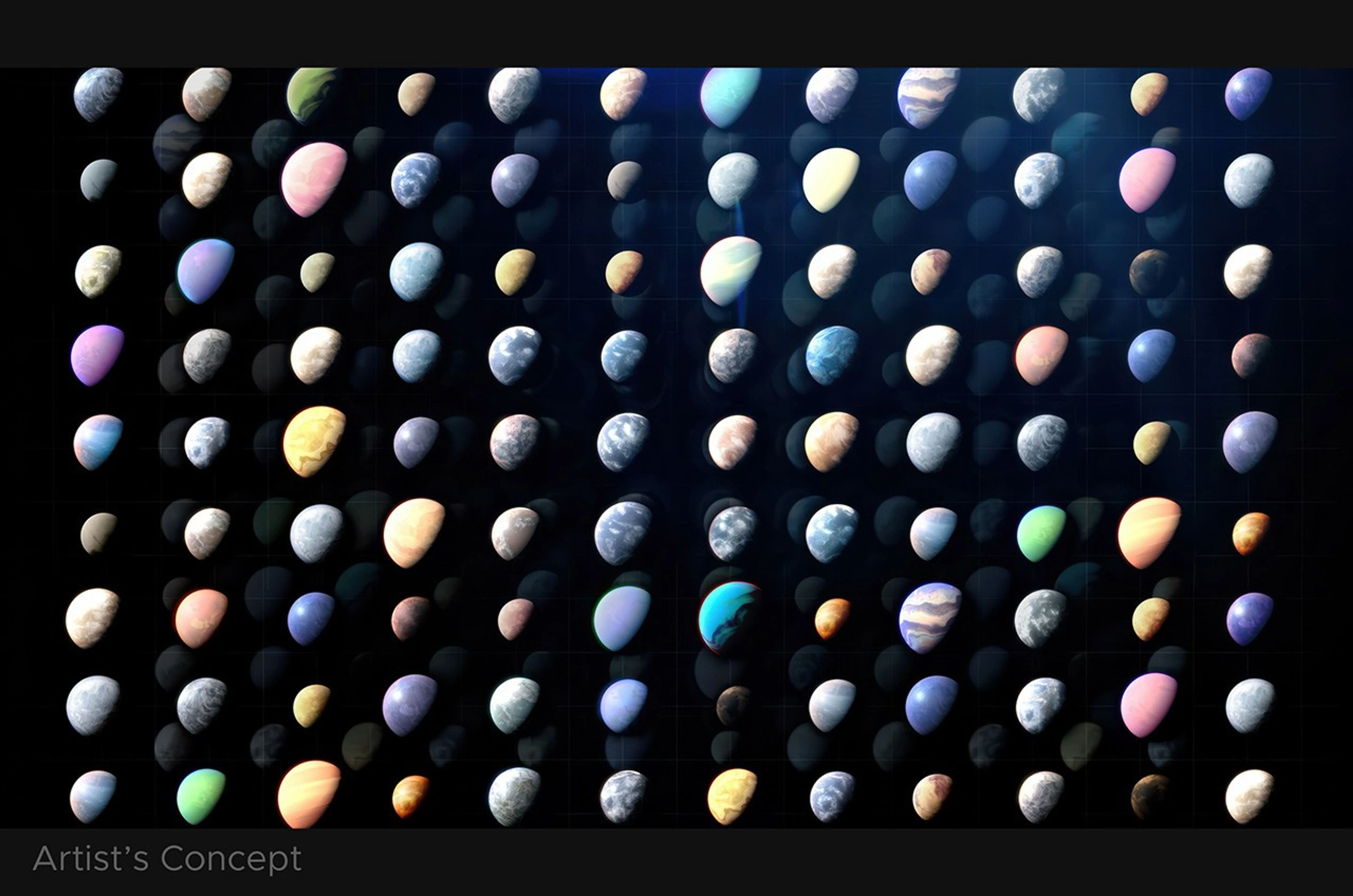
Over the coming decades, we could build a catalogue:
Continents resolved. Ice caps tracked across seasons. And the same ring that carries the light carries its spectrum: perhaps the chemical signs of life[4].
Each probe, a dedicated observatory: one star, one world, one long stare. So we’d prioritise the nearest candidates, temperate worlds with atmospheric hints worth following up. Proxima b. TRAPPIST-1e. LHS 1140 b.
V. An Age of Wonders Lies Beyond
The Solar Gravitational Lens has existed since the Sun formed. Every star creates one. The optics follow from general relativity. The price is institutional: decades of patience, billions of dollars, and a mission that pays off only once it’s farther than any spacecraft we’ve ever flown.
For most of history, knowledge required presence. Then telescopes made distance visible. The SGL would do something stranger: turn a star into an instrument and make geography visible at interstellar range.
And the maps have a vessel. The Free Starship goes where the lens has looked.
After planetfall, it sends a probe to the destination star’s focal line. The station that mapped the world becomes one end of an interstellar link. Eshleman’s title promised both: observations and communications.[3]
At 650 AU, a small spacecraft stares at a thread-thin ring of light around the Sun, an Einstein ring carrying light from another world. Over months, a continent appears.
The Sun built the lens. We can build the mission.
Technical Appendix
Values are representative of published mission studies. Exact figures depend on wavelength, coronagraph design, and reconstruction assumptions.
A. Mission Physics
Deconvolution recovers the map—analogous to Event Horizon Telescope imaging.
-
Focal distance: The focal line begins at ~547 AU (where f = R☉²/2rg, with rg the Sun’s Schwarzschild radius) and extends outward. Light grazing the Sun’s limb is deflected by ~1.75 arcseconds. See [2], [4] for derivations.
-
Optical gain: ~10¹⁰–10¹¹ brightness amplification at optical/near-IR wavelengths [4]. This pushes the photon budget into a fundamentally different regime from conventional telescopes.
-
Image formation: The planet appears as an Einstein ring. At 30 parsecs and 650 AU, the projected Earth is about 1.3 kilometres wide. A ten-metre image-plane step corresponds to roughly a hundred kilometres on the source [6].
-
Integration time: Months to a year. Earlier idealised models support megapixel-class maps [4, 5]. The 2026 end-to-end benchmark recovers 200–230-kilometre broadband structure under its stated assumptions [6]. Nearer targets require less time.
-
Propulsion: Solar sails with sundiver manoeuvres can achieve tens of AU/year exit velocities [8]. Laser propulsion could reduce times further [9].
-
Navigation: Metre-to-ten-metre transverse metrology and control maintained for years. The Sun, telescope, and target must remain aligned while all three move [6].
-
Mission architecture: Modular spacecraft launched in sequence provide redundancy and assemble in flight [11]. Each target requires a separate mission along its own focal line. Optical laser links return data from 550+ AU.
-
Why no alternative works: Space interferometers need ~100 km baselines. Fast flybys spend only minutes at target with prohibitive communication challenges. Each non-SGL approach falls 2–5 orders of magnitude short [4].
B. Falsifier Register
The essay’s claims, and what would break them. The gates are physical rather than calendared: the lens waits on engineering, not on events with schedules.
B.1 — The corona, at first mission-level study. The claim: optical-wavelength imaging survives the Sun’s glare behind a coronagraph, because corona noise that is severe at radio wavelengths is far weaker at optical ones [12]. This is the register’s foundation stone. If mission-level modelling or a precursor coronagraph demonstration shows the ring’s photon budget drowned at optical wavelengths for an Earth analogue at tens of parsecs, the imaging claim fails at its root. Every other entry assumes B.1 holds.
B.2 — Navigation, at first deep-space demonstration. The claim: metre-to-ten-metre image-plane metrology and control held for years. If precursor flights cannot hold that class, the 200–230-kilometre reconstruction coarsens beyond continental geography. The map degrades before the mission fails.
B.3 — The reconstruction, checkable now. Earlier idealised models support megapixel maps [4, 5]. A 2026 benchmark adds photon noise, temporal variability, coronal residuals, detector calibration, optical-model error, and navigation error. It recovers 200–230-kilometre broadband structure, not tens-of-kilometre detail [6]. The body therefore claims continental geography. Fine coastlines remain the stretch case.
B.4 — The transit, at first sundiver. The 15–25 year timeline requires sundiver solar sails reaching tens of AU per year [8], or laser propulsion faster still [9, 10]. If the first flown sundiver-class sail falls an order of magnitude short, the focal line recedes to Voyager timescales and the mission slips a generation. The lens does not move. It waits.
References
[1] Einstein, A. (1915). “Die Feldgleichungen der Gravitation” / “The Field Equations of Gravitation.” Sitzungsberichte der Königlich Preußischen Akademie der Wissenschaften (Berlin), 844–847. (Einstein’s field equations establishing general relativity. Foundation for gravitational lensing.)
[2] Einstein, A. (1936). “Lens-Like Action of a Star by the Deviation of Light in the Gravitational Field.” Science 84(2188), 506–507. (Einstein’s original calculation showing that a star can act as a gravitational lens.)
[3] Eshleman, V.R. (1979). “Gravitational Lens of the Sun: Its Potential for Observations and Communications over Interstellar Distances.” Science 205(4411), 1133–1135. (First proposal to use the solar gravitational lens for astronomy and interstellar communications.)
[4] Turyshev, S.G. & Toth, V.T. (2020). “Direct Multipixel Imaging and Spectroscopy of an Exoplanet with a Solar Gravity Lens Mission.” arXiv:2002.11871. (A 1-metre telescope at 550 AU could image an Earth analogue at 30 pc with ~10 km-scale resolution.)
[5] Turyshev, S.G. & Toth, V.T. (2023). “Imaging faint sources with the extended solar gravitational lens.” Physical Review D 107, 104063. See also: open version, arXiv:2301.07495. (Updated modelling of imaging faint sources, solar oblateness effects, and deconvolution feasibility.)
[6] Turyshev, S.G. (2026). “Direct High-Resolution Imaging of Earth-like Exoplanets with the Solar Gravitational Lens.” arXiv:2606.14899. (An end-to-end scalar benchmark including photon noise, temporal variability, coronal and calibration residuals, model mismatch, and navigation error; 200–230-kilometre recovered broadband structure for an Earth analogue at 30 pc with a one-metre telescope at 650 AU.)
[7] NASA Science / Jet Propulsion Laboratory. “Where Are Voyager 1 and Voyager 2 Now?” (Current probe distances, for context on deep-space timelines.)
[8] Landis, G.A. (2016). “Mission to the Gravitational Focus of the Sun: A Critical Analysis.” arXiv:1604.06351. (Critical analysis of SGL mission feasibility and propulsion, including solar-sail architectures.)
[9] Manchester, Z. & Loeb, A. (2017). “Stability of a Light Sail Riding on a Laser Beam.” Astrophysical Journal Letters 837, L20. (Laser-sail propulsion dynamics relevant to fast SGL delivery.)
[10] Breakthrough Initiatives. “Breakthrough Starshot.” (Laser-sail mission concept relevant to SGL delivery architectures.)
[11] NASA Innovative Advanced Concepts (NIAC) (2020). “Direct Multipixel Imaging and Spectroscopy of an Exoplanet with a Solar Gravitational Lens Mission.” (NASA-funded mission concept development for the SGL observatory architecture.)
[12] Turyshev, S.G. & Toth, V.T. (2018). “Diffraction of light by the gravitational field of the Sun and the solar corona.” (SGL modelling including solar-corona plasma effects: severe at radio wavelengths, far weaker at optical wavelengths, hence the coronagraph.)