Love is the Foundation
Money scales. Only love founds.
There is a story we tell about what holds civilisation together. In the story, the foundation is the market: self-interest, coordinated by price, scaled by money. Love is a private comfort the system permits once it is rich enough to afford it.
The story is backwards. The market moves mountains, and money is one of the most powerful instruments humanity has ever built. But it is not the foundation. It sits on top of one. Trace any functioning market back far enough and every path terminates in an act that no market could have paid for.
Love.
I. The Market Stands on What It Cannot Produce
Every voluntary exchange rests on a foundation it did not create.
Property and contract depend on courts, law, and a settled peace. The counterparty depends on years of care no firm could ever recoup, because the worker is free to walk away. Money rests on collective trust. Markets consume breathable air, basic research, and a stable society.
Markets are extraordinary at allocating on top of these things. They cannot produce their own preconditions. Some benefits reach people who never paid for them. Others exceed anything their maker can recover. All require institutions standing outside the exchange. Karl Polanyi made the point a lifetime ago: the self-regulating market is a utopian abstraction. Real markets have always been embedded in the social and political institutions that constitute them.[1]
The foundation is invisible while it works, the way grammar is invisible to a fluent speaker. You notice it only when it fails: a financial crisis, a pandemic, a region the grid never reached.
The market did not create its own foundation.
II. Only Love Founds
Three forces bind people together: love, money, and fear. Only money scales.
And that measures the wrong thing.
Money scales in reach. It lets a million strangers who will never meet cooperate. But reach tells us little about what sustains that cooperation. The thing that reaches furthest is not the thing everything else stands on.
Every market participant began as a child someone had to keep alive.
For years, someone feeds the child, comforts it, and answers when it cries. Long before the child can earn, promise, or repay, someone has to give.
That is love doing what money cannot.
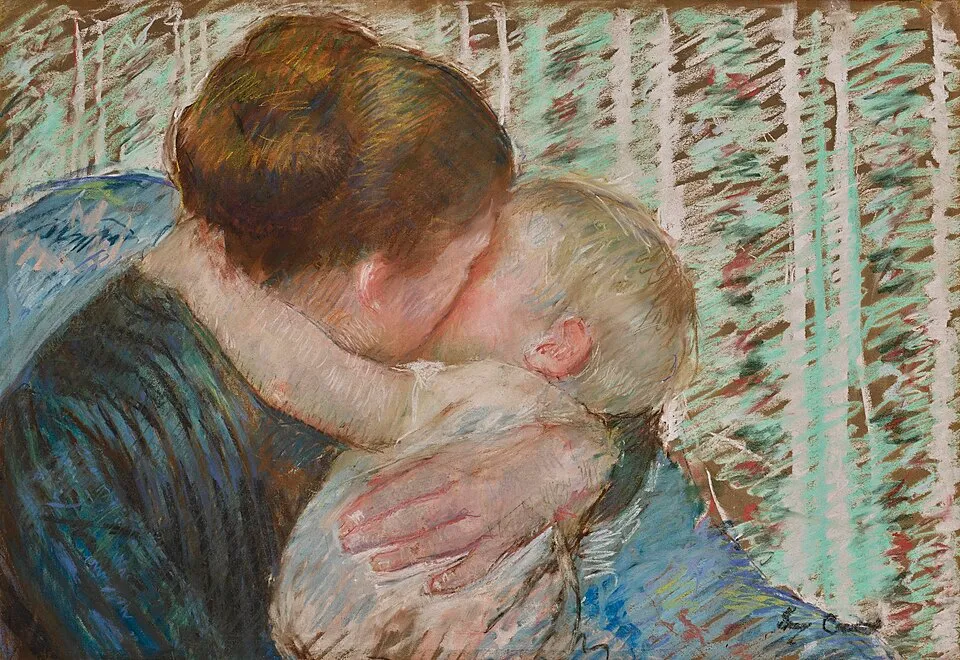
Capitalism does not manufacture its own participants. It inherits years of care from the household, much of it absent from the accounts.[2]
Money is a prosthetic for love at scale: a way to get some of the cooperation that “I care about your wellbeing” produces, between strangers who cannot possibly care about each other. It is brilliant precisely because it does not require love. But a prosthetic presupposes the limb it extends.
Love is the foundation. It produces the participants, the trust, and the care that no market can.
Fear is the perimeter. It enforces from the outside when love runs out.
Money is the plumbing. It extends cooperation past the horizon of the known.
III. Giving Without Return
Reciprocity does not prove love: I help you so that you will help me. That is exchange with a delay. A critic can collapse most warm behaviour into disguised self-interest, and often be right.
Now consider a friend in crisis who can give nothing back. Or the care given to the dying. Someone stays beside the bed after repayment has ceased to be the question.
An act given for its own sake, expecting nothing.
IV. Love Simply Shows Up
Fear has to be continuously enforced. It is a structure you build when you cannot command belief, coercion standing in for loyalty. It is expensive, constantly resupplied, and decays the instant the force stops. Love requires no external enforcement. It is freely given, or it is not love at all. It may cost everything to give. Nothing outside it has to compel it. It propagates on its own.
The difference is noticeable: an institution that holds people with clauses and deadlines cannot survive the removal of its enforcer. An institution that holds them because they believe in it grows even where no enforcer pushes.
An old saying, traditionally attributed to Napoleon, gives the contrast its starkest form:
Alexander, Caesar, Charlemagne, and I founded empires upon force. Jesus founded his upon love—and to this hour, millions would die for him.[3]
Whether or not he said those words, Napoleon died watching his own empire dissolve.
The movement set beside it began with a man who commanded no army, held no office, wrote no book, and was executed as a criminal. Two millennia later, it remains. Christian institutions have also used force. But the invitation at the movement’s beginning asks something else of us: love your neighbour.
Love is what lasts.
V. Creation as Gift
Follow non-reciprocity far enough and it runs past economics into something larger.
Consider the first act of all, creation itself. There was no reciprocity in that moment, because there was no one yet to reciprocate with. Whatever you take the origin of the universe to be, it was not an exchange.
If you allow the theological word, this is creation as gift. The oldest theology gave it a name: bonum diffusivum sui, the good is self-diffusive, it overflows by its nature.[4] A complete being creates freely. What is given for its own sake, expecting no return, is love. Read this way, the universe is the first non-reciprocal act: love at the scale of everything.
Spinoza reached the same ground from the other side. Deus sive Natura—God, or equivalently, Nature: one infinite substance of which everything is an expression, the order of the world seen from the inside rather than commanded from without.[5]
Under that lens, the sacred runs through everything. Einstein, asked whether he believed in God, said he believed in “Spinoza’s God, who reveals himself in the orderly harmony of what exists.”[6]
The First Epistle of John gives it three words: God is love.[7] Not has love. Is love. The ground of being identified with self-giving itself. Reasoned up from markets, or read down from scripture. It is the same sentence.
VI. The Same Ground in Everyone
One deep reading of the carpenter’s claim to be a child of God is not that he was claiming a unique exception. It is that he was revealing something universal: this is what you are, too. A prodigy of the spirit, someone who saw early and clearly what is equally true of everyone, and pointed at it. The mystics across every tradition have said the same: that the divine is not only far and transcendent but near and immanent, in the ground of each person. The inner light. The spark in the soul. The self that is one with the whole.[8]
Notice what this does. It levels. If the ground is in everyone, then seeing it sets no one above anyone. It dissolves the above and below entirely. That is the test of whether the vision has substance: it should make everyone luminous, not the one who sees it. The genuine seers grow humbler as they see more, because what they see is shared.
We are all standing on the same foundation. To see it is not to be raised above others. It is to be bound to them.
You do not have to call yourself religious to arrive here. It is the destination of a mind that follows the foundation all the way down.
VII. Which Is Why Access Is Everything
If the foundation is love, the work follows directly.
The universe is abundant beyond measure. The first gift, more than enough. Scarcity, where people suffer it, is not in the gift. It is in us: a failure of access, infrastructure, and will. The work is closing that gap.
Energy access determines how a human life goes. The night map still records the gap.[9] It is brutal.
When energy is scarce, societies are forced into zero-sum trade-offs. Cruelty starts to look like arithmetic. When it becomes abundant, those justifications collapse. It grows harder to rationalise suffering when the means to prevent it are everywhere. Material abundance enables moral expansion. Build the infrastructure of access, and it becomes harder to look away from suffering.
And the proof is already in the ledgers. Every early buyer of a solar panel paid more than the machine would soon cost. The learning their purchases funded flowed to everyone who came after, beyond any hope of capture. The cheapest electricity in history carries that uncaptured value in its price curve.
The work of building access is belief with a pulse. Reliable power for a tailor whose machine sits idle. For a mother who wants only to sell music by the road and lift her children. That is the practical form of loving your neighbour: treating each person as one who carries the same ground you found in yourself.
Money scales. Fear enforces. But only love founds.
Everything this series reached for rests on that foundation. Senses extended until the universe came into view. Energy enough to lift every life, and computation enough to give every mind its full reach. A Sun bent into a lens to photograph distant worlds, and ships free enough to sail toward them, across a bridge where the last century saw only fire. The scale changes. The work still has someone to be for.
To see it is to inherit the work, and the work takes a thousand forms. One life builds, another teaches, another heals, another simply refuses to let a neighbour go without. The form is the gift each person has to give. The obligation beneath them all is one.
Take what is abundant, and carry it to those it has not yet reached.
References
[1] Polanyi, K. (1944). “The Great Transformation: The Political and Economic Origins of Our Time.” Beacon Press. (The self-regulating market as a utopian abstraction; markets as embedded in social and political institutions.)
[2] Folbre, N. (2001). “The Invisible Heart: Economics and Family Values.” The New Press. See also: Waring, M. (1988). “If Women Counted: A New Feminist Economics.” Reissued as “Counting for Nothing: What Men Value and What Women Are Worth.” (On the uncounted care economy that sustains the measured one.)
[3] Attributed to Napoleon Bonaparte; published in Beauterne, R. F. A. de, ed. (1841). “Sentiment de Napoléon sur la divinité de Jésus-Christ.” Déhécourt. (Pensées recueillies à Sainte-Hélène par le comte de Montholon and published by Beauterne; the attribution is traditional and should be treated cautiously.)
[4] Pseudo-Dionysius, “The Divine Names.” See also: Thomas Aquinas, “Summa Theologiae,” I, q.19, a.2 and I, q.20, a.2. (Bonum diffusivum sui—“the good is diffusive of itself”; creation understood as gift rather than need.)
[5] Spinoza, B. (1677). “Ethics” (Ethica, Ordine Geometrico Demonstrata). (Deus sive Natura; a single infinite substance; the intellectual love of God.)
[6] Einstein, A. (1929), in reply to Rabbi Herbert S. Goldstein. “Professor Einstein Declares His Faith in Spinoza’s God.” Jewish Telegraphic Agency archive. (Widely documented: “I believe in Spinoza’s God, who reveals himself in the orderly harmony of what exists.”)
[7] First Epistle of John 4:8, 4:16. “God is love.”
[8] On divine immanence across traditions: Meister Eckhart, “Sermons” (the birth of the Son in the ground of the soul); the Quaker “Inner Light”; the Vedantic identity of Atman and Brahman; the Sufi concept of Haqq / Ana’l-Ḥaqq (the Real). See Huxley, A. (1945), “The Perennial Philosophy.”
[9] International Energy Agency (2025). “Achieving access for all.” World Energy Outlook 2025. (Roughly 700 million people worldwide live without access to electricity.)